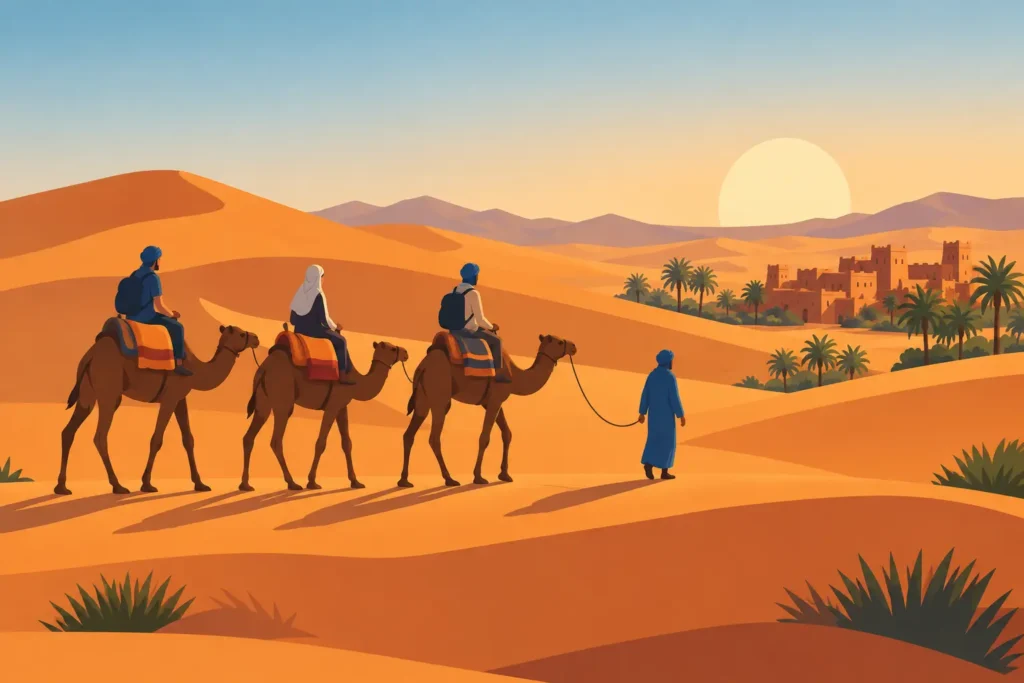
The moment your camel leaves the last line of Merzouga hotels and enters the dunes, the noise of the road disappears. To book a Sahara camel trek well, the key is not simply choosing a camel ride. It is choosing the right desert, timing, camp standard and road itinerary so the experience feels calm, comfortable and truly Moroccan.
For most travellers, a camel trek is one memorable part of a wider Morocco holiday. It may follow days in Marrakech, the High Atlas and Ait Ben Haddou, or come after time in Fes and the cedar forests of the Middle Atlas. A locally planned private journey makes those connections easier, with your driver, accommodation and desert camp organised around your pace.
Choose the right Sahara desert area
Merzouga, beside the Erg Chebbi dunes in south-east Morocco, is the strongest choice for travellers who want the classic Sahara image: tall rolling dunes, golden light, long horizons and an overnight camp reached by camel. The dunes begin close to the village, so you can arrive by vehicle, meet your camel team and be in the sand within minutes.
Zagora is a worthwhile alternative if your schedule is short, particularly from Marrakech. However, its landscape is stonier and the dunes are smaller. It can offer a pleasant desert night, but it does not deliver the scale of Erg Chebbi. If the camel trek is a highlight of your trip rather than a brief stop, allow the extra journey time for Merzouga.
From Marrakech, most private routes to Merzouga need at least three days and two nights. A four-day journey is more relaxed, giving you more time for the kasbahs, valleys and mountain scenery along the way. From Fes, a two- or three-day route works well, often travelling through Ifrane, Midelt and the Ziz Valley before reaching the desert.
When to book a Sahara camel trek
Spring and autumn are usually the most comfortable seasons. From March to May and September to November, daytime temperatures are generally manageable and evenings are pleasantly cool. These months are popular, so booking in advance is sensible, especially for private camps and family rooms.
Summer can be extremely hot in the Sahara. A trek is still possible, but it should be timed close to sunset and planned with realistic expectations. Travellers who dislike intense heat may prefer the Atlas Mountains, imperial cities or Atlantic coast during July and August, then save the desert for another season.
Winter offers clear skies and beautiful daytime light, but nights in the dunes can become very cold. A quality camp should provide proper bedding, blankets and private tents where requested. Bring warm layers, socks and a hat for the evening around the campfire. Desert weather changes quickly after sunset, even when the afternoon feels warm.
Decide what kind of camel experience you want
A standard sunset trek typically lasts between 45 minutes and 90 minutes each way, depending on the camp location and the route through the dunes. You ride out in late afternoon, watch the changing colours of the sand, enjoy dinner at camp and return after sunrise the next morning. For many first-time visitors, this is the right balance of adventure and comfort.
Longer camel rides can be arranged for travellers who specifically want more time in the dunes. They are not always better. Camel saddles can become uncomfortable, and a multi-hour ride is physically demanding for some guests. A private guide can adapt the route, include walking breaks and arrange 4×4 transfers when needed.
You do not have to ride a camel to enjoy a Sahara camp. This matters for young children, older travellers, people with back concerns or anyone who feels uneasy around animals. A 4×4 transfer can take you to the camp while still preserving the sunset, dune walk, dinner and night under the stars. Tell your tour planner what feels comfortable rather than assuming the camel ride is compulsory.
Know the difference between desert camps
Camp quality changes the entire experience. A basic camp may have shared facilities, simple tents and a modest dinner. It can suit travellers looking for a traditional, uncomplicated night in the desert. A luxury camp usually offers larger private tents, proper beds, private bathrooms or nearby en-suite facilities, electricity, thoughtful décor and more refined meals.
Neither choice is automatically right. Families and couples celebrating a special occasion often appreciate the privacy and warmth of a luxury camp. Travellers focused on value may prefer a comfortable standard camp and spend more of their budget on a longer private route. What matters is receiving a clear description of the tent, bathroom arrangements, meals and transport before you confirm.
Ask whether the camp is set among the dunes or at their edge. A camp deeper in Erg Chebbi can feel more remote, but it may involve a longer camel ride. Camps closer to the edge are easier to reach and can be better for guests with limited mobility. The best option depends on how much time you want on the camel and how remote you want the evening to feel.
What should be included in your booking
A well-organised Sahara experience should make the practical details simple. Your itinerary should state the collection point, private transport, driver or guide service, camel ride or 4×4 transfer, dinner, breakfast, camp category and return arrangements. If you are joining the trek as part of a multi-day tour, confirm each overnight stop and the approximate daily driving time.
Also ask about luggage. Most camps request that larger suitcases remain securely in the vehicle or at the hotel while you take an overnight bag to the dunes. Pack a change of clothes, toiletries, medication, a small torch, sunglasses, sun cream and a reusable water bottle. A scarf is useful for wind and sand, though it is not necessary to dress like a film character to enjoy the desert.
Food requirements should be discussed before departure. Moroccan desert camps can cater for vegetarian, vegan, gluten-free and other dietary needs when notified in advance. The same applies to birthdays, anniversaries, private dining and family arrangements. This is where a private operator has an advantage over a fixed group departure: details can be planned around you.
Travel with camel welfare in mind
A camel trek should be unhurried and respectful. Look for an operator that uses experienced local camel handlers, avoids overloading animals and gives guests clear help with mounting and dismounting. Camels stand up in stages, which can feel surprising the first time, so hold on as instructed and let the handler guide the process.
It is reasonable to ask how the animals are cared for and whether the trek duration can be adjusted. Responsible travel is not about expecting a perfectly silent, polished activity. It is about choosing local teams who know their animals, work at a sensible pace and treat guests and animals with care.
Build the trek into a route worth remembering
The road to the Sahara is part of the experience. From Marrakech, a classic private route crosses the High Atlas via the Tizi n’Tichka pass, visits Ait Ben Haddou, continues through Ouarzazate and the Valley of the Roses, then follows the Road of a Thousand Kasbahs towards the Todra Gorge and Merzouga. From Fes, the route reveals a different Morocco, from mountain towns and forests to palm-filled valleys and desert plains.
Rushing from Marrakech to the dunes in one day is possible only as a very long drive and rarely feels enjoyable. Give the journey room to breathe. Stop for a local lunch, photograph the kasbah landscapes and spend a night in the Dades Valley or near the Todra Gorge before reaching the sand.
At Morocco Customised Tours, private Sahara routes can be shaped around your arrival city, travel dates, preferred hotel level and the kind of camp experience you want. Our Moroccan-born drivers and guides know the routes, desert communities and practical rhythms of the journey, so you can focus on the places rather than the logistics.
The best time to arrive at camp is before the sky turns fully dark. Leave space to climb a nearby dune, watch the last light fade over Erg Chebbi and listen to the desert settle around you. That quiet moment, more than the camel ride itself, is often what travellers carry home with them.