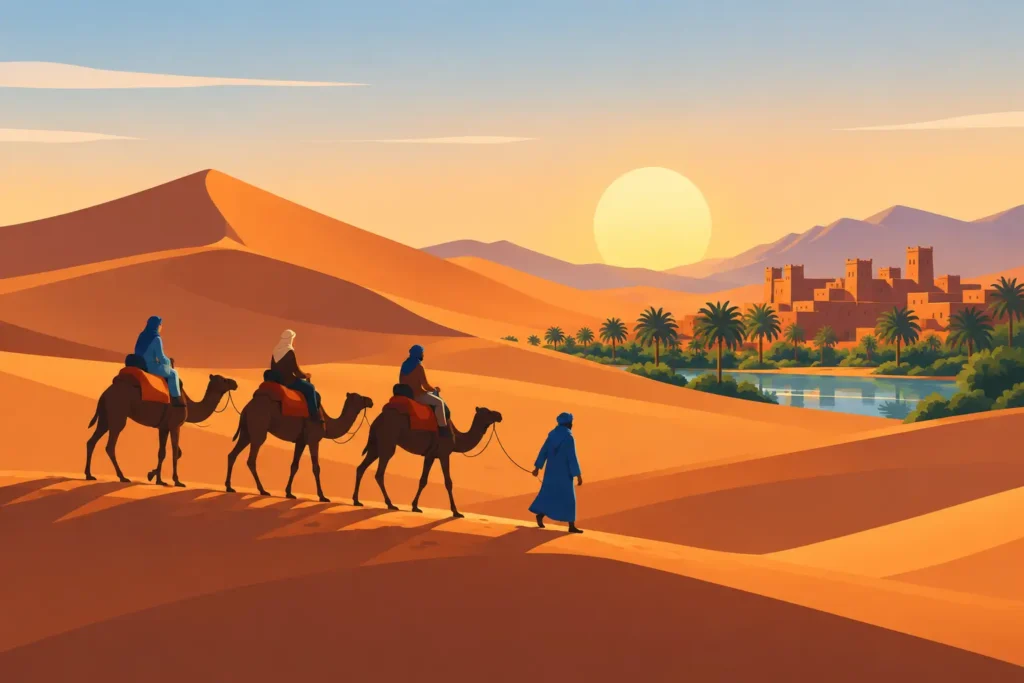
The moment the road leaves the last palms of the Draa Valley behind, Morocco changes pace. Villages become farther apart, kasbahs rise from the earth-coloured landscape, and the dunes of Erg Chebbi begin to appear on the horizon. Morocco desert tours are not simply a camel ride and a night in a tent. They are a journey through mountain passes, historic trading routes, Berber villages and one of North Africa’s most memorable landscapes.
For travellers planning their first Moroccan holiday, the Sahara can feel far away on a map. It is. That is why the route, number of nights and level of comfort make such a difference. A private tour gives you the time to reach the desert properly, stop where the scenery is at its best and travel with a local driver-guide who understands the roads, the communities and the rhythm of the country.
Choosing the right Morocco desert tour
Most Sahara journeys are designed around Erg Chebbi, near Merzouga in south-east Morocco. These towering orange dunes are the classic image many visitors have in mind, and they provide the best setting for camel trekking, desert camps, sunrise walks and 4×4 excursions. The key decision is how you get there and how much time you can give the journey.
A three-day tour from Marrakech is the most popular option for travellers with limited time. The route crosses the High Atlas Mountains via the Tizi n’Tichka pass, visits Ait Ben Haddou, and continues through Ouarzazate, the Valley of the Roses and the dramatic Todra Gorge before arriving in Merzouga. It is a full itinerary, with long driving sections, but it lets you experience several of Morocco’s great landscapes in one trip.
Four days from Marrakech is often the better choice. The extra night removes some of the pressure from the road, allowing time for a slower visit to the Dades Valley, more photographs in the gorges or a relaxed morning at camp. It also gives your guide flexibility if you would rather spend longer at a village market, stop for lunch with a view, or arrive at the dunes before the afternoon light fades.
Starting in Fes offers a different journey. A Fes to Merzouga desert tour typically travels through Ifrane, the cedar forests near Azrou, Midelt and the Ziz Valley. This route is especially useful for travellers planning an imperial cities itinerary, perhaps arriving in Casablanca and finishing in Marrakech. Rather than retracing your steps, you move across Morocco in a logical, scenic line.
Marrakech or Fes: which departure point works best?
Choose Marrakech if you want the strongest contrast between the lively medina, the High Atlas and the Sahara. It suits a first visit and works well for couples, families and small groups who want an iconic Morocco route.
Choose Fes if your holiday includes the northern cities, Chefchaouen or Casablanca. The road through the Middle Atlas is less focused on film-set kasbahs and more on changing terrain, cedar woodland and broad valleys. Both routes reach the same desert, but the experience on the way is different.
If you have seven days or more, a private circuit connecting Marrakech, the desert and Fes is the most rewarding option. It avoids backtracking and combines Morocco’s major highlights with enough breathing room to enjoy them.
What a well-planned desert itinerary should include
The desert itself is the highlight, but the road to Merzouga is part of the experience. A thoughtfully planned itinerary balances famous sights with practical travel times. There is little value in arriving at camp exhausted after spending the entire day in a vehicle.
Your tour should include comfortable, air-conditioned private transport, an experienced English-speaking driver-guide, carefully selected accommodation and a clear plan for meals and activities. At Morocco Customized Tours, private journeys are built around your travel dates, preferred pace and hotel standard, with local teams who can adjust details before you arrive.
A typical Sahara stay includes a transfer by camel or 4×4 from the edge of the dunes to camp. Camel rides are a traditional and atmospheric way to enter the desert, particularly near sunset. They are not mandatory, however. Some guests prefer a 4×4 transfer because of mobility needs, young children or simple comfort. A good operator will offer both without making you feel that you are missing out.
At camp, expect a warm welcome, a Moroccan dinner and an evening under a remarkably clear sky. Luxury desert camps generally offer proper beds, private bathrooms, electricity and more spacious tents, while standard camps provide a simpler but still comfortable experience. The best choice depends on your expectations. A luxury camp is ideal for a honeymoon, anniversary or travellers who value privacy. A standard camp can be perfect for guests who want a more straightforward desert night and are happy to prioritise the journey over extra facilities.
Beyond the dunes: experiences worth adding
Merzouga is not only about sand. An extra morning or afternoon opens the door to experiences that many rushed itineraries miss. Visit the village of Khamlia for Gnawa music rooted in a deep cultural history, take a 4×4 excursion around the dunes, meet families in nearby desert settlements, or search for fossils in the black-rock hamada beyond Erg Chebbi.
These moments are where local knowledge matters. Respectful visits should never feel staged or intrusive. A Moroccan guide with real community connections can explain local customs, arrange stops responsibly and help you understand what you are seeing rather than simply ticking off locations.
How many days do you need for the Sahara?
For a return trip from Marrakech, three days is the minimum practical duration. It is best for travellers who have a short Morocco holiday and accept that there will be long drives. Four days offers a far more relaxed pace and is the recommended option for most private groups.
Five days gives you time to add a second desert night or explore the Draa Valley and southern kasbah routes in greater depth. This is a strong choice for travellers who want the desert to feel like a meaningful part of their holiday, not a quick overnight stop.
A longer one-way route from Marrakech to Fes, or the reverse, works particularly well over four to six days. It makes the desert a natural bridge between regions, leaving you free to enjoy the medinas, coast or mountains afterwards. The right answer depends on your route, not just the number of days available.
When to travel and what to pack
Spring and autumn are the most comfortable seasons for desert travel. From March to May and September to November, daytime temperatures are usually pleasant, although evenings can still turn cool. Summer brings intense heat, especially in July and August, so early starts, air-conditioned transport and a well-equipped camp become essential. Winter days can be beautiful and clear, but nights in the Sahara are cold. Pack layers even if the forecast looks sunny.
Bring light, loose clothing, closed shoes for walking on rocky ground, sunglasses, sunscreen and a scarf for wind or sand. A small day bag is useful for your camp night, as larger luggage may stay in the vehicle. Do not rely on desert camps to provide every personal item: bring a refillable water bottle, any medicines you need and a warm layer for after sunset.
Photography is rewarding in the Sahara, but the desert is not a studio. Sand can get into cameras and mobile phones, and conditions change quickly. A simple protective pouch and a soft cloth will save trouble. More importantly, put the camera down for part of the evening. The quiet after dark is one of the reasons people remember the desert long after the journey ends.
Why private travel makes the difference
Group tours can be attractive on price, but they follow fixed timings and rarely allow much room for personal interests. On a private Morocco desert tour, you can choose your collection point, hotel category, stops and travel pace. Families may need breaks and earlier dinners. Couples may want a quieter camp. Food-focused travellers may prefer a local lunch in the valley rather than a standard roadside stop.
Private does not have to mean overly formal. It means having someone responsible for the details while you enjoy the country. Your driver-guide can explain the changing regions, help with practical requests and adapt the day when weather, road conditions or your energy level call for a change.
Before confirming any desert trip, ask what is included, how many hours of driving are planned each day, whether the camp has private facilities, and whether camel transfers are optional. These small questions prevent surprises and help match the tour to the experience you actually want.
The Sahara rewards travellers who give it time. Choose a route that fits your wider Morocco holiday, leave space for the unexpected roadside stop, and let the journey to the dunes become as memorable as the night beneath the stars.