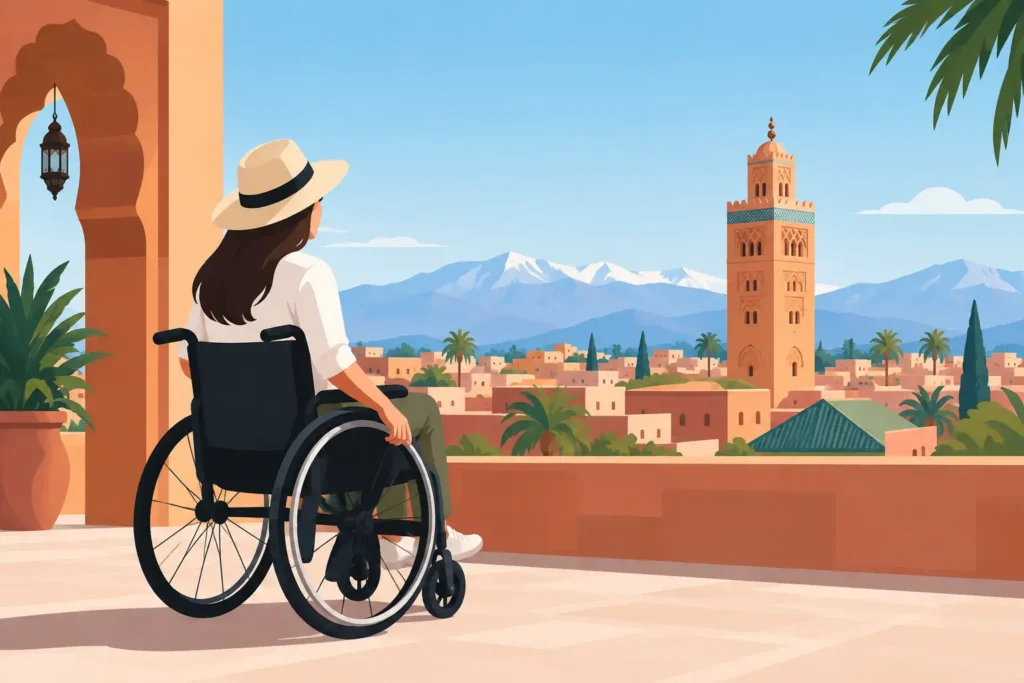
A riad courtyard in Marrakech, a sunset over the dunes near Merzouga, the blue lanes of Chefchaouen – Morocco wheelchair travel can be deeply rewarding, but it needs honest planning rather than assumptions. Access is improving in many hotels, museums and newer public spaces, yet historic medinas, mountain villages and desert camps can present real barriers. A private, flexible itinerary makes the difference between spending the holiday solving problems and simply enjoying Morocco.
What to expect from wheelchair travel in Morocco
Morocco is not a destination where accessibility is standardised. A hotel described as accessible may have a ground-floor room and a wide entrance but no roll-in shower. A restaurant may have step-free access from one street yet steps at another entrance. In the older parts of Marrakech and Fes, surfaces can be uneven, lanes can be narrow, and kerbs are often high.
That does not mean these places are off limits. It means each element should be checked in detail before booking. Travellers using a manual wheelchair, a compact power chair, or a mobility scooter will have different requirements, particularly for vehicle transfers, gradients and bathroom layouts. The most successful trips are built around what works reliably, with enough time in each place to avoid rushed connections.
Moroccan people are famously welcoming and practical. Hotel teams, drivers and local guides will often go out of their way to assist. However, goodwill is not a substitute for confirmed access. Clear communication before arrival protects your comfort and independence.
Start with an accessible route, not a fixed package
For many guests, Marrakech is the simplest arrival point. It has a wide choice of modern hotels, international flights and attractions that can be adapted around mobility needs. The newer districts of Gueliz and Hivernage generally offer smoother pavements, wider streets and more contemporary properties than the ancient medina.
A well-paced private route might begin with three nights in Marrakech, continue through the High Atlas foothills and Ouarzazate, then reach the Sahara near Merzouga. From there, travellers can return to Marrakech or travel onward towards Fes with overnight stops planned around comfortable accommodation. This is a spectacular route, but it involves long driving days and some uneven terrain. It suits travellers who are happy to enjoy the desert from an adapted lodge or accessible camp area rather than expecting full access to every dune activity.
For a more city-focused holiday, Casablanca, Rabat, Tangier and Chefchaouen can be combined. Casablanca and Rabat have newer urban infrastructure and flatter areas, while Tangier offers a more manageable coastal base than some hillier towns. Chefchaouen is beautiful but steep, cobbled and difficult in sections. It is best approached as a carefully planned overnight stay, not as a destination to explore without support.
Fes is one of Morocco’s great cultural experiences, but its medina is particularly challenging for wheelchair users. A local guide can select accessible viewpoints, workshops and restaurants around the edges, while a driver can manage transfers between key areas. The heart of the medina may be impractical for some travellers, especially with a larger chair. Being realistic here creates a far better day.
Private transport is the foundation of a comfortable trip
Public transport is rarely the best option for wheelchair users travelling between Moroccan cities. Train stations and airports vary in accessibility, and assistance arrangements should never be left to chance. A private vehicle with an experienced driver gives you control over stops, luggage, timing and route changes.
Before confirming transport, share the wheelchair’s folded dimensions, weight and battery type if it is powered. Ask whether the vehicle has enough boot space, whether the chair must be lifted, and who will assist at each stop. A spacious van may be suitable for a folding manual wheelchair, while a heavier power chair may require a vehicle with a ramp or lift. These arrangements need to be confirmed specifically, not assumed from vehicle photographs.
Longer Morocco routes involve distances that can surprise first-time visitors. Marrakech to Merzouga is usually divided over two days for good reason. Building in a relaxed lunch stop, accessible toilet break and an overnight stay turns a transfer into part of the experience. Your driver can also choose safer drop-off points close to entrances, which is valuable in busy medinas and at popular monuments.
Choosing accommodation with the right details
Morocco has wonderful riads, boutique hotels and desert lodges, but character properties often include steps, narrow doors and traditional bathrooms. For wheelchair travel, modern hotels or carefully selected ground-floor riads are usually the most dependable choice.
Ask for practical information rather than simply requesting an accessible room. The essentials include step-free access from the vehicle to the bedroom, doorway width, bathroom turning space, shower threshold, grab rails and the location of the nearest accessible public toilet. If you travel with a companion, check whether there is room for both beds and the wheelchair without making the room difficult to use.
A pool, spa or rooftop terrace may be part of the hotel’s appeal, but these features can be inaccessible even when the bedroom works well. Decide what matters most for your holiday: an authentic medina setting, an easy shower, a lift, a pool, or a quiet ground-floor room. There are trade-offs, and the right property depends on your priorities.
For the Sahara, a permanent desert lodge is often easier than a traditional tent camp. Some camps can arrange a tent near the entrance, portable ramps or an accessible bathroom, but sand remains a challenge. A lodge at the edge of the dunes can still provide sunset views, Berber hospitality, music by the fire and a memorable desert atmosphere with fewer physical obstacles.
Experiences worth planning around
The best accessible experiences in Morocco are not limited to indoor attractions. In Marrakech, the Jardin Majorelle has more manageable paths than much of the medina, while Bahia Palace can be enjoyed in selected areas with assistance. A private food experience, artisan visit or hammam adapted to your needs can bring the city’s culture close without requiring hours on rough lanes.
In the Atlas region, scenic drives, panoramic terraces and village lunch stops offer the beauty of the mountains without demanding a strenuous walk. Around Ouarzazate, film studios and the Kasbah Taourirt area can be approached selectively. At Ait Ben Haddou, the lower village and view across the riverbed are often more realistic than climbing through the historic ksar.
Near Merzouga, consider a 4×4 excursion on firmer desert tracks, a sunset stop at the dunes, or tea with a local family. Camel rides are not suitable for every traveller and may involve difficult mounting and dismounting. There is no need to force the classic image of a Sahara holiday when a private desert experience can be shaped around your comfort.
How to prepare before you fly
Speak with your airline well ahead of departure about wheelchair assistance, battery rules and the handling of mobility equipment. Keep the chair’s specifications, battery information and a photograph with you. If your wheelchair can be disassembled, label removable parts and consider travelling with a small repair kit, puncture supplies and any essential spares.
Bring a lightweight cushion if you use one, medication in hand luggage, and a universal plug adaptor. Morocco’s warm weather can be tiring, especially from late spring through early autumn, so plan outdoor sightseeing early in the morning or later in the afternoon. Winter brings cooler evenings and occasional rain, particularly in the mountains, but can be very pleasant for city touring and the desert.
It also helps to discuss personal assistance openly. A guide can arrange seating, identify accessible routes and communicate with venues in Arabic or French, but they are not a medical carer unless this has been agreed in advance. Travellers who need transfer support should bring a companion or arrange suitable care as part of the trip plan.
Why local planning matters for Morocco wheelchair travel
Online descriptions rarely capture the small details that shape a day in Morocco: a step at the entrance, a steep lane after rain, a restaurant with a usable side door, or a hotel whose lift is too narrow for a power chair. Local inspection and direct conversations with suppliers are more useful than generic accessibility labels.
At Morocco Customised Tours, we create private routes around real access needs, not a one-size-fits-all itinerary. We can balance Morocco’s headline experiences with sensible hotel choices, dedicated transport and guides who understand when a change of plan will make the day easier. Tell us how you travel, what support you need and which places matter most. Morocco has plenty to offer when the journey is designed around you.