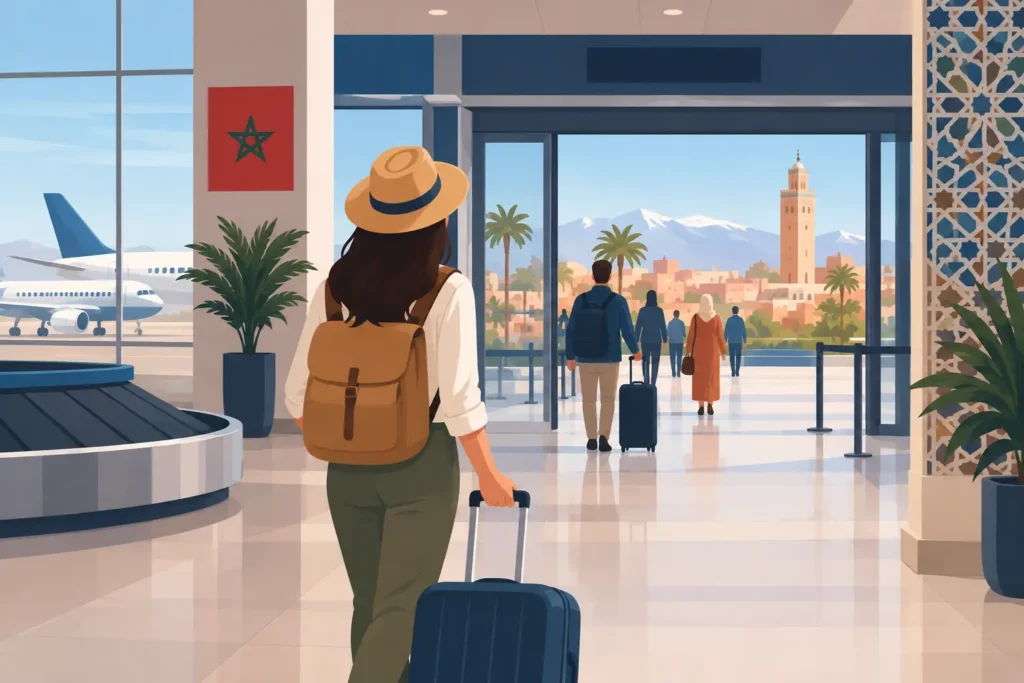
After a long flight, the first hour in Morocco can shape the start of your whole holiday. The queues, unfamiliar currency and offers of taxis outside the terminal are easy to manage when you know what to expect. This Morocco airport arrival guide explains the practical details our local team wants first-time visitors to know, whether you land in Marrakech, Casablanca, Fes, Tangier or Agadir.
Before you leave the aircraft
Keep your passport, accommodation address and return or onward travel details in your hand luggage. Border officers may ask where you are staying, the purpose of your visit and how long you plan to remain in Morocco. A calm, straightforward answer is all that is usually needed.
British passport holders generally do not need a visa for tourist stays of up to 90 days, but entry rules can change. Check the latest official guidance before departure and make sure your passport meets Morocco’s current validity requirements. If you are travelling on a different passport, confirm your own visa conditions well before booking flights.
If you take prescription medicine, carry it in its original packaging along with a copy of the prescription or a doctor’s letter. This is especially sensible for stronger pain medication, controlled medicines and larger quantities. Morocco has strict rules around some products, so do not pack drones, professional filming equipment or anything unusual without checking the required permissions first.
Morocco airport arrival guide: passport control and baggage
At passport control, follow the signs for arrivals and join the non-resident queue. Processing time depends on how many flights have arrived together. Marrakech Menara can be busy around popular European arrival times, while Casablanca Mohammed V may involve a longer walk and larger queues because it is the country’s main international hub.
Your passport will be stamped on entry. Before leaving the desk, quickly check that the stamp is clear and correct. Keep your passport secure throughout your stay because you will need it for hotels, domestic flights, car hire and departure.
After immigration, collect your luggage and pass through customs. Most travellers walk through without difficulty, but customs officers can inspect bags. Be honest if asked about cash, equipment or goods you are bringing into the country. Morocco is welcoming to visitors, but border procedures should be treated seriously.
If a checked bag does not appear, go directly to your airline’s baggage desk before exiting the baggage hall. File a report, photograph the reference number and give an address where the bag can be delivered. If you are beginning a private tour, tell your driver or tour coordinator immediately so they can adjust the first day’s plans where possible.
Cash, cards and mobile data
The Moroccan dirham is a closed currency, meaning it is not always easy to obtain before travelling and there are limits on taking it out of the country. The simplest option is to withdraw cash from an airport ATM after baggage collection. Start with a modest amount for tips, small purchases and places that do not accept cards, then use ATMs in towns and cities as needed.
Cards are widely accepted in better hotels, larger restaurants, riads with international guests and established shops. They are less dependable in small medinas, rural villages and local cafés. Carrying a mix of cash and a bank card gives you flexibility. Notify your bank before travelling, and always keep some cash separate from your main wallet.
Airport exchange counters are convenient, though rates may not be the best available. They are useful if you need immediate cash but do not exchange your entire holiday budget on arrival. Keep exchange receipts if you may want to convert leftover dirhams before leaving Morocco.
For data, you can buy a local SIM card in the arrivals area or arrange an eSIM before flying. Maroc Telecom, Orange and inwi are the main networks, and coverage is good in cities and along major routes. In the Sahara, Atlas Mountains and remote valleys, service can be limited or disappear entirely. Download offline maps, hotel details and key booking information before setting off.
Choosing the right airport transfer
This is where advance planning makes the biggest difference. Taxis are available at Moroccan airports, but the experience varies by city, time of day and your confidence negotiating. After a night flight, with children, large luggage or a first visit to Morocco, a pre-arranged private transfer is usually the more comfortable choice.
A reliable driver meets you at the arrivals exit with a name sign, helps with luggage and takes you directly to your hotel or riad. This is particularly helpful in Marrakech and Fes, where many traditional riads sit inside pedestrian-only medinas. Your vehicle can reach the nearest permitted point, then a local porter or hotel staff member may assist with the final walk.
If you choose an airport taxi, use the official taxi rank rather than accepting offers inside the terminal. Agree the fare before getting in if there is no clearly displayed fixed price. Ask whether luggage, late-night travel or tolls are included. Keep small notes available, as drivers may not always have change for large denominations.
Public transport can be good value, especially from Casablanca. However, it is not always the best first step after an international flight. A train or bus may be suitable for confident independent travellers with light luggage and a daytime arrival. It is less attractive if you are heading straight to a medina, arriving after dark or beginning a tightly planned itinerary.
Morocco Customised Tours can arrange private airport collection as part of a custom holiday or multi-day route. Having one local contact from the airport onwards means your driver, accommodation and next destination are coordinated from day one.
Your first journey into the city
The drive from the airport is a useful introduction to Morocco, but it is not the moment to judge the whole country. Roads near major airports are generally modern and well maintained, then the character changes as you approach a city centre or old medina. Scooters, pedestrians, horse-drawn carts and lively traffic are normal parts of urban life.
In Marrakech, Marrakech Menara Airport is close to the medina and newer districts, so transfers are often short. In Casablanca, Mohammed V Airport sits well outside the city, making the journey considerably longer. Fes-Saïss is also outside the old city, and Tangier Ibn Battouta is a practical gateway for northern Morocco, Chefchaouen and the Mediterranean coast.
If your itinerary begins with a long drive, such as Marrakech to the Dades Valley or Fes to Merzouga, consider spending the first night near your arrival city. The Sahara is unforgettable, but it deserves an unhurried start. A rested morning departure is safer and more enjoyable than several hours on the road after an overnight flight.
First-night essentials in Morocco
Once you arrive, take a few minutes to settle practical matters before heading out. Ask your accommodation for a business card or save its location offline. Medina streets can be wonderfully atmospheric but confusing at first, especially after dark. Keep your host’s mobile number available and agree a clear meeting point if you are travelling separately from your group.
Dress comfortably and respectfully, particularly when walking through residential areas. Morocco is diverse and used to international visitors, yet modest clothing helps you feel at ease and is appreciated in traditional settings. There is no need to overthink it: loose, comfortable layers are ideal for airports, city walks and changing evening temperatures.
Drink bottled or filtered water if you have a sensitive stomach, and ease into rich food rather than making your first meal an ambitious feast. Mint tea is part of Moroccan hospitality, but it is often sweet. If you prefer less sugar, simply ask for it unsweetened or with little sugar.
A small amount of tipping is customary for helpful service, including porters and drivers. There is no fixed rule for every situation, and the right amount depends on the service received. A few dirhams for minor assistance and a more thoughtful tip for excellent guiding or driving are both appreciated.
Arrival mistakes worth avoiding
Do not leave the terminal without a transport plan, particularly at night. Do not rely on a card alone, assume your hotel is reachable by car, or let an unfamiliar person handle your documents. These are not reasons to worry – they are simple habits that make travel easier.
Also avoid trying to fit too much into your arrival day. Morocco rewards travellers who allow time for its rhythm: a tea on a rooftop, the call to prayer carrying across a square, a first stroll through a market, then a good night’s rest before the road opens ahead of you.
Your holiday should begin with reassurance, not logistics. Arrange the details that matter, leave room for the unexpected, and let your first Moroccan welcome be the start of a journey designed around you.