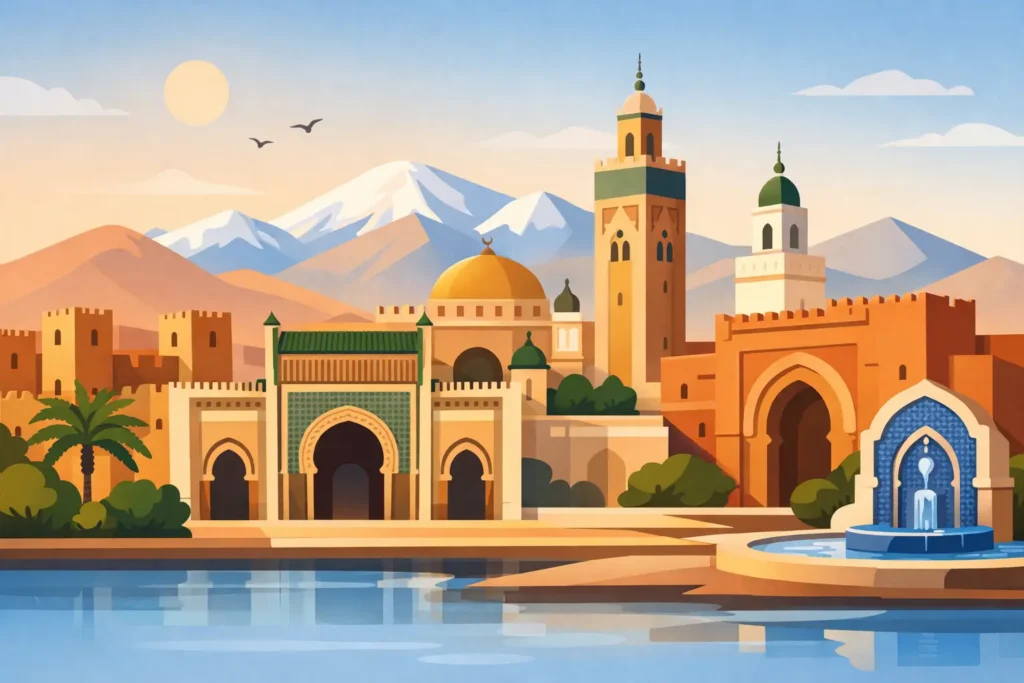
Marrakech may be the first name on many Morocco itineraries, but the country’s royal story is written across four very different cities. This imperial cities travel guide helps you plan a route through Marrakech, Fes, Meknes and Rabat with enough time to enjoy the details, not simply collect photographs. Each was once a capital of a Moroccan dynasty, and each reveals a different side of the country: palace gates, medieval medinas, sacred learning, gardens, craft traditions and modern civic life.
For most first-time visitors, the best approach is a private journey with a dedicated driver-guide. The distances are manageable, but Morocco’s imperial cities are richer when transport, medina access, hotel check-ins and local guidance are arranged around your pace. You can focus on the experience while someone local handles the practical details.
Which cities belong on your route?
Morocco’s four imperial cities are Marrakech, Fes, Meknes and Rabat. They are not interchangeable stops, and the right itinerary depends on your arrival airport, holiday length and interests.
Marrakech is energetic, colourful and social. Its old medina is full of souks, historic monuments, rooftop restaurants and the changing theatre of Jemaa el-Fna. It is the strongest choice for travellers who want atmosphere, food, gardens and easy access to the High Atlas Mountains.
Fes offers a more intense historical experience. Fes el-Bali is one of the world’s great living medinas: a dense maze of lanes where artisans, Quranic schools, traditional fondouks and family-run shops remain part of daily life. It rewards travellers who are curious, patient and willing to walk.
Meknes is quieter and often overlooked, which is precisely part of its appeal. The city carries the legacy of Sultan Moulay Ismail in its monumental gates, royal granaries and vast palace district. It works particularly well for couples and families who prefer a calmer pace after Fes.
Rabat, Morocco’s current capital, brings a different balance. It has wide boulevards, diplomatic quarters, the Hassan Tower, the Mausoleum of Mohammed V, the Kasbah of the Udayas and an Atlantic-facing setting. Rabat is less hectic than Marrakech or Fes and suits travellers looking for refined hotels, coastal air and a clear view of contemporary Morocco.
Imperial cities travel guide: choose the right duration
A seven-day route can introduce all four cities, but it will feel brisk. Ten days gives you the breathing space to add Volubilis, Chefchaouen, the Atlas Mountains or a short Sahara extension. For a private tour, the best route is usually shaped around your flight times rather than forcing a fixed circuit.
A focused 7-day imperial cities route
Arrive in Marrakech and spend two nights exploring the medina, Bahia Palace, Saadian Tombs, Majorelle Garden area and Jemaa el-Fna. On the third day, travel north towards Fes, breaking the journey with a stop in Beni Mellal or another scenic point depending on the season and your preferred driving time.
Give Fes two nights. One full day with a licensed local guide is worthwhile, especially in the medina where streets are rarely marked in a way that makes independent navigation easy. Continue to Meknes for an overnight stay, with time for Bab Mansour, the royal stables and Moulay Ismail’s city. The following day, visit Volubilis before travelling to Rabat for your final night, then depart from Rabat or Casablanca.
This route is efficient, but it involves several travel days. It is best for travellers who are happy to see the highlights and do not mind changing hotels frequently.
A more comfortable 10-day route
With ten days, begin with three nights in Marrakech. This allows for a half-day city tour and either a relaxed day in the city or a private trip into the Atlas Mountains. Travel to Fes with an overnight stop en route, or take a longer direct transfer if you would rather unpack less often.
Stay three nights in Fes, including a full medina tour and time to explore at your own pace. From Fes, travel via Volubilis to Meknes, then continue towards Chefchaouen for two nights if the blue mountain town is on your wish list. Finish with one or two nights in Rabat before departing from Casablanca, which is under two hours away by road in normal conditions.
For travellers who dream of the Sahara, the itinerary needs more time. A desert extension from Fes to Merzouga is possible, but it adds long driving days and is best done over at least three additional nights. It is a wonderful combination, though it should not be squeezed into a short imperial cities holiday merely for the sake of saying you have seen the dunes.
What to see in each imperial city
In Marrakech, plan your sightseeing around the heat. Morning is ideal for the Ben Youssef Madrasa, Bahia Palace and the souks, while late afternoon suits the Koutoubia area and Jemaa el-Fna. A guided food experience or an evening meal in the medina can add depth beyond the main monuments. Choose a riad inside or near the old city if you want to walk to major sights, but consider a resort-style hotel in Hivernage or the Palmeraie if pools, space and easy vehicle access matter more.
Fes is best experienced with context. A local guide can explain the history of the Al Quaraouiyine area, show you traditional crafts without turning the day into a shopping trip, and help you understand the rhythm of the medina. The tanneries are a classic stop, but the quieter moments often stay with visitors longer: watching copper workers at their benches, hearing the call to prayer travel through the lanes, or sharing mint tea on a riad terrace.
Meknes deserves more than a rushed photo at Bab Mansour. Its monumental architecture reflects the ambitions of Moulay Ismail, who built on a remarkable scale in the seventeenth century. Pair the city with nearby Volubilis, Morocco’s best-known Roman archaeological site. The mosaics, columns and views across the countryside create a useful contrast with the enclosed medinas of Fes and Marrakech.
In Rabat, visit the Hassan Tower and Mausoleum of Mohammed V, then walk through the blue-and-white Kasbah of the Udayas towards the Bouregreg River. The city feels open and orderly, yet its old quarters still offer traditional markets and local cafés. Rabat is also a sensible place to slow down before a flight, particularly after a busy route through Morocco’s interior.
When to travel and what to expect
Spring and autumn are generally the most comfortable seasons for an imperial cities itinerary. March to May brings green landscapes and mild temperatures, while September to November usually offers warm days with cooler evenings. Summer can be very hot in Marrakech, Fes and Meknes. Travelling is still possible, but early starts, air-conditioned transport and accommodation with a pool make a real difference.
Winter is often excellent for city touring. Days can be bright and pleasant, though nights are cold in Fes and Meknes, and rain is more likely in the north. Pack layers, comfortable closed shoes and a light waterproof jacket. Modest clothing is appreciated when visiting religious and traditional areas, and a scarf or shawl is useful for sun, cool evenings and mosque-adjacent sites.
The medinas are working neighbourhoods, not open-air museums. Expect uneven surfaces, steps, scooters and occasional crowds. Travellers with reduced mobility can still enjoy Morocco, but the itinerary should be designed carefully, with accessible hotels, vehicle drop-off points and a realistic amount of walking. A private programme gives far more flexibility than a large group tour.
Why local planning changes the experience
The major sites are easy to identify on a map. The difference lies in how your day unfolds: where your driver can meet you after a medina walk, which entrance avoids the busiest approach, when a monument is closed for restoration, and which restaurant genuinely suits your preferences.
A well-planned private tour also makes room for personal interests. Art and architecture lovers may spend longer in Fes and Meknes. Food-focused travellers may prefer additional nights in Marrakech. Families often appreciate a gentler rhythm with more time in Rabat or an Atlas day trip between city stays. Morocco Customised Tours builds routes around these choices, with Moroccan-born drivers and guides who can support guests in English, French or Spanish.
Leave space in the schedule for the small moments: a fresh orange juice beside a Marrakech square, bread coming from a Fes bakery, a quiet garden in Rabat, or sunset over the Meknes walls. Those are often the memories that turn a well-organised route into a Morocco holiday you will want to revisit.