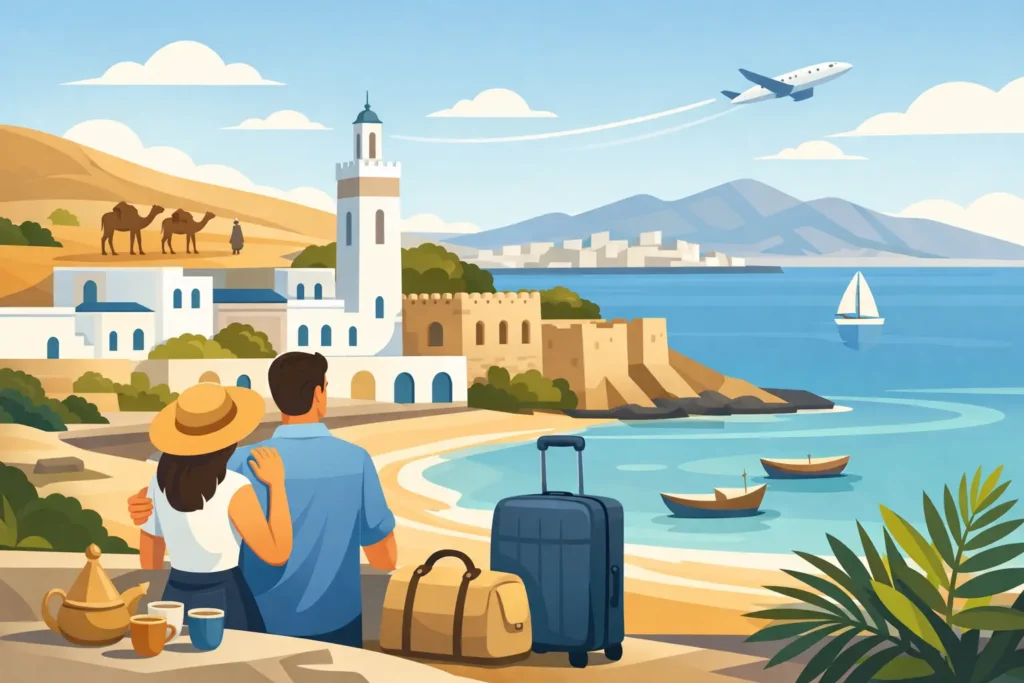
Tangier is more than a convenient arrival point. It is where the Mediterranean meets the Atlantic, where white hillside houses face Spain across the Strait of Gibraltar, and where northern Morocco begins to reveal its many layers. A Tangier private Morocco itinerary is an excellent choice for travellers who want to begin calmly, then travel south through blue mountain towns, imperial cities, desert landscapes and Marrakech without arranging every transfer, hotel and guide themselves.
For most first-time visitors, seven days gives a rewarding introduction to the country. It is a full route, with several driving days, so private transport makes a real difference. You can stop when the scenery calls for it, set a comfortable departure time and travel with a Moroccan driver-guide who understands the roads, customs and best local places to pause.
Why start your private Morocco tour in Tangier?
Tangier has direct connections from Europe and an increasingly popular international airport, but its real advantage is its position. From here, Chefchaouen is within easy reach, Fes follows naturally, and the journey can continue across the Middle Atlas towards Merzouga and the Sahara before finishing in Marrakech.
This route is best for travellers who want to see Morocco from north to south rather than return repeatedly to the same city. It brings together the Rif Mountains, ancient medinas, cedar forests, desert dunes and the High Atlas in one holiday. The trade-off is distance: Morocco is larger than many visitors expect. A private itinerary keeps these long stretches comfortable and turns the road itself into part of the experience.
A 7-day Tangier private Morocco itinerary
Day 1: Tangier arrival and the northern coast
Meet your private driver at Tangier Ibn Battuta Airport, the ferry port or your hotel. Depending on your arrival time, begin with a relaxed introduction to the city. Tangier’s old medina is compact enough to explore on foot, with winding lanes, small markets and views over the harbour. The Kasbah district offers a quieter atmosphere and excellent perspectives across the water.
If time allows, drive to Cap Spartel, where the Atlantic Ocean and Mediterranean Sea meet, then continue to the Caves of Hercules. These are classic Tangier sights, but the timing matters. A late-afternoon visit is often more pleasant than going with the busiest daytime crowds.
Spend the night in Tangier. For a short stay, a well-located riad or hotel near the medina makes the evening easy and gives you time for a Moroccan dinner without another drive.
Day 2: Tangier to Chefchaouen
After breakfast, travel through the green hills of northern Morocco towards Chefchaouen. The journey usually takes around two and a half to three hours, although a private tour may take longer if you choose scenic stops or a village lunch along the route.
Chefchaouen is known for its blue-painted streets, but it should not be rushed as a photo stop. Arrive with time to walk through the medina, browse local woven goods and enjoy a mint tea in Plaza Uta el-Hammam. The town’s slower rhythm is part of its appeal. In the evening, the call to prayer echoes through the valley and the mountain air becomes noticeably cooler.
An overnight stay is preferable to a same-day return or hurried transfer to Fes. It allows you to see the town early the next morning, when the narrow lanes are at their quietest.
Day 3: Chefchaouen to Fes
Leave Chefchaouen after breakfast and head south-east towards Fes. This is a longer travel day, generally around four to five hours, but the scenery shifts from the Rif Mountains to broad agricultural plains and historic towns.
Arrive in Fes in the afternoon and settle into your riad within or near the old medina. The approach to Fes can feel intense at first, which is exactly why a private driver and local guide are valuable. The medina is one of the world’s largest pedestrian urban areas, and knowing where to enter, where to meet and how to avoid wasting time matters.
Keep this first evening simple. Enjoy the rooftop view from your riad, take a short walk in the nearby lanes and rest before a full day of guided discovery.
Day 4: Guided Fes medina and imperial heritage
Fes deserves an experienced local guide. Its medina is not built around a single grand boulevard; it is a living maze of workshops, bakeries, fountains, mosques and family-run businesses. A well-planned private visit can include the Royal Palace gates, the Jewish quarter of Mellah, panoramic views from Borj Sud and the historic heart of Fes el-Bali.
Inside the medina, you may visit traditional tanneries, artisan workshops and the exterior of Al Quaraouiyine, one of the oldest continually operating educational institutions in the world. Your guide can adapt the pace to your interests, whether that means architecture, Moroccan cuisine, crafts or everyday life.
Avoid trying to see every corner. Fes is best experienced with time for conversation and a relaxed lunch, not as a checklist. A private guide can also help you distinguish genuine craftsmanship from shops designed only for rushed tourist groups.
Day 5: Fes to Merzouga via the Middle Atlas
This is the longest driving day on the route, usually eight to nine hours with stops, and it is where private travel is particularly worthwhile. Depart early from Fes and pass through Ifrane, a neat mountain town known for its alpine-style architecture, before reaching the cedar forests around Azrou. Barbary macaques are sometimes seen here, although wildlife sightings should never be guaranteed.
Continue through Midelt and the Ziz Valley, where dramatic gorges give way to palm-filled oases and fortified villages. By late afternoon, the first Erg Chebbi dunes rise from the horizon near Merzouga.
From the desert edge, travel by camel or four-wheel drive to your camp, depending on your preference and physical comfort. Camel trekking is memorable, but it is not essential. A four-wheel-drive transfer is a better choice for young children, travellers with mobility concerns or anyone who simply prefers an easier arrival. Spend the night in a desert camp with dinner, local music and a clear view of the stars.
Day 6: Merzouga to Dades Valley
Wake early if you would like to see sunrise over the dunes, then return to the vehicle for the journey west. Today’s route offers a different side of southern Morocco: fossils, desert villages, rocky plains and the landscapes around Tinghir.
Visit Todra Gorge, where high limestone walls close around a narrow riverbed. It is a good place for a short walk before continuing towards the Dades Valley. The road through this region is known for its kasbahs, rose-growing areas and striking red rock formations.
Stay overnight in the Dades Valley or nearby Ouarzazate. Dades is quieter and more scenic, while Ouarzazate offers a wider choice of larger hotels. The right choice depends on whether you value a peaceful valley setting or more amenities after several days on the road.
Day 7: Ait Ben Haddou, High Atlas and Marrakech
Your final day takes you through the Route of a Thousand Kasbahs to Ait Ben Haddou, a historic earthen ksar that has appeared in many international films and television productions. Walk through its lanes with a guide or take time to admire the view from across the river.
Continue over the High Atlas Mountains via the Tizi n’Tichka pass, weather permitting. The road is winding but spectacular, with changing views of valleys, terraced fields and Berber villages. Arrive in Marrakech by late afternoon or evening, where your Tangier-to-Marrakech journey ends with a final transfer to your accommodation.
How to tailor the route to your travel style
A private Morocco itinerary should follow your priorities, not force you into a fixed timetable. Couples often choose upgraded riads, boutique desert camps and private dining experiences. Families may prefer shorter driving stages, four-wheel-drive camp transfers and hotels with pools. Travellers who are more interested in culture than the desert can add an extra night in Fes or Chefchaouen and finish in Casablanca instead.
The season also changes the journey. Spring and autumn usually offer the most comfortable temperatures across the country. Summer can be very hot in Merzouga and Marrakech, while winter nights in the Sahara are cold despite sunny days. Mountain roads can be affected by snow or heavy weather in winter, so routes should always remain flexible.
With Morocco Customized Tours, your driver, accommodation style, sightseeing pace and desert experience can be arranged around the way you want to travel. That local planning is especially useful on a cross-country route where the details determine whether the trip feels rushed or beautifully paced.
Give yourself one or two additional nights in Marrakech if your schedule allows. After the changing roads, colours and landscapes from Tangier to the Sahara, it is the right place to slow down, enjoy a hammam or rooftop dinner, and let Morocco’s final impressions settle in.