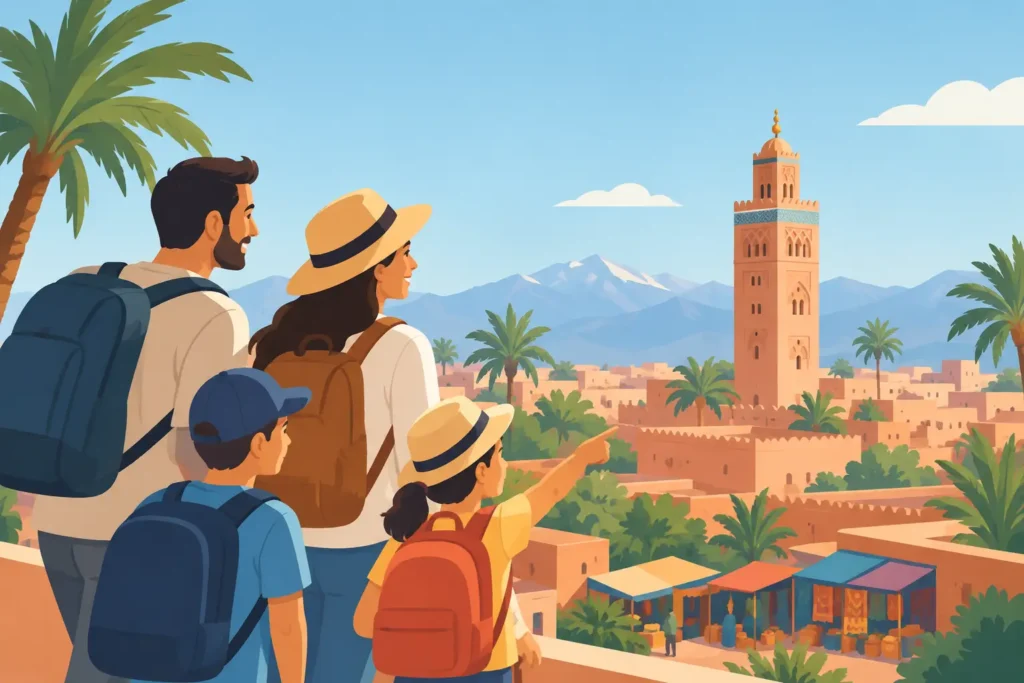
The first call to prayer may wake your family before sunrise in Marrakech, while a camel ride near Merzouga may become the story your children repeat for years. To prepare children for Morocco travel, it helps to set expectations before you leave home: this is a colourful, welcoming country with busy medinas, long scenic roads and new sounds, tastes and customs. With the right pace and local support, it can be one of the most rewarding family holidays in North Africa.
Prepare children for Morocco travel before departure
Children usually cope well with a new country when they know the basic shape of the journey. Show them a map of Morocco and explain the route in simple terms. Marrakech, Fes, the Atlas Mountains, Ait Ben Haddou and the Sahara are not just names on an itinerary – they are different places with different weather, landscapes and rhythms.
Talk positively and honestly about what they may notice. Medina streets can be narrow and lively, with scooters, handcarts, shopkeepers and people moving in every direction. In rural areas, they may see donkeys, goats and families working the land. The desert is beautiful but can be hot by day and surprisingly cold after sunset. When these details are familiar in advance, children tend to meet them with curiosity rather than anxiety.
If your children are old enough, involve them in one small decision. Let them choose a snack for the road, a question to ask a guide, or whether they would rather visit a pottery workshop or spend longer by the hotel pool. A private itinerary makes this easier because each day can be adjusted around your family rather than a fixed coach timetable.
Sort documents, health and insurance early
Each child needs their own valid passport, and families should check entry requirements well before booking flights. Carry copies of passports, travel insurance details, accommodation information and any medical prescriptions. Keep essential medicines in your hand luggage, along with a basic kit containing plasters, child-safe pain relief, rehydration sachets and any medication your child uses regularly.
For individual medical advice, vaccinations or concerns relating to a child’s age and health, speak with a qualified travel health professional before departure. This matters especially if your itinerary includes remote mountain villages or several nights in the desert, where a pharmacy may not be nearby.
Build a family itinerary with breathing room
Morocco rewards travellers who do not try to see every highlight at full speed. A family can certainly combine Marrakech, the Atlas Mountains and the Sahara, but a route needs sensible overnight stops. The drive from Marrakech to Merzouga is a full journey through mountain passes, kasbah landscapes and desert valleys. It is memorable, yet it is not ideal to treat as a race.
For younger children, allow regular comfort breaks and avoid stacking late arrivals with early departures. Two nights in Marrakech can work well before travelling south. A night in Ouarzazate or the Dades Valley breaks up the route to the Sahara, while two nights in Fes give children time to recover after a longer travel day. If you have limited time, it may be better to choose one region well than attempt Marrakech, Fes, Chefchaouen and Merzouga in a rushed week.
A private driver-guide offers a practical advantage here. You can stop when a child needs the toilet, wants a snack, or simply needs ten minutes outside the vehicle. Local guides also know which viewpoints, family-run cafés and quieter stops suit a family better than the busiest roadside options.
Plan for the age of your children
Babies and toddlers need shade, reliable naps and easy access to supplies, so shorter driving days and hotels with a pool or garden are worth prioritising. A properly fitted child seat should be requested in advance rather than assumed. Bring a familiar comfort item for sleeping, as new rooms and early starts can be unsettling.
School-age children often enjoy Morocco most when there is something practical to do: baking bread, spotting date palms, learning how carpets are made, trying a few Arabic or Amazigh greetings, or watching the stars outside a desert camp. Teenagers may appreciate the photography, food, architecture and independence of browsing a clearly agreed section of a souk with an adult nearby. The best plan depends on your family, not a generic idea of what a Morocco tour should include.
Pack for sun, layers and everyday comfort
Morocco’s climate changes considerably by season and region. Marrakech can be very hot in summer; the Atlas Mountains and desert camps can feel cold in the evening; coastal cities may be breezier. Pack light layers rather than relying on one heavy outfit. Comfortable closed shoes are useful for uneven medina lanes, kasbah steps and desert sand, while sandals are convenient at hotels and pools.
A wide-brimmed hat, sunglasses, refillable water bottle and high-factor sun cream should be within easy reach each day. For children, include a light long-sleeved top for sun protection and modesty in towns and villages. Modest clothing is not about making children uncomfortable. It is a simple, respectful choice that also protects skin from the sun.
Bring familiar snacks for the first days, particularly for selective eaters. Moroccan supermarkets and hotels offer plenty of options, but a small supply of trusted cereal bars, crackers or dried fruit can prevent a hungry child becoming overwhelmed during a drive. Pack wipes and hand sanitiser for excursions, but use them alongside normal handwashing whenever possible.
Help children enjoy Moroccan food safely
Moroccan meals are often family-friendly. Fresh bread, grilled meats, couscous, rice, omelettes, soups, fruit and pastries are easy starting points. Tagines vary widely: chicken with lemon and olives, beef with prunes, or vegetables with spices may suit children differently. Ask for mild seasoning where needed, then let older children sample spices at their own pace.
Use bottled or properly treated water for drinking and brushing teeth if advised by your accommodation or guide. Encourage children to drink regularly, particularly on warm days and during desert excursions. Choose busy, clean restaurants and freshly cooked food, and be cautious with foods that have been left standing in the heat. This is sensible travel practice, not a reason to avoid local cuisine.
If your child has allergies or dietary needs, tell your tour planner before arrival and remind hotel and restaurant staff clearly. A private itinerary gives more time to arrange suitable meals, rather than hoping a group lunch stop will have the right options.
Prepare for medinas, markets and local customs
The souks of Marrakech and Fes can feel exciting and intense at the same time. Before entering, agree a simple family rule: stay close, stop immediately if separated, and identify what to do if anyone cannot see the group. For young children, holding hands in the busiest lanes is sensible. Choose a meeting point that is easy to recognise, such as a hotel entrance or landmark, rather than an unmarked corner inside the medina.
Teach children that asking before taking someone’s photograph is polite. They may be fascinated by artisans, musicians, market stalls and traditional clothing, but people are not scenery. A local guide can explain customs naturally and help create respectful interactions that feel more meaningful than a quick photograph.
Moroccans are known for their warmth towards children, and families may receive kind attention in cafés, shops and hotels. Still, children should use the same common-sense boundaries they would anywhere else: remain with their adults, avoid accepting food or gifts without permission, and keep mobile phones or valuables secure.
Make the Sahara exciting, not exhausting
For many families, the Sahara is the emotional centre of a Morocco holiday. Riding over Erg Chebbi’s dunes at sunset, listening to music at camp and seeing a sky full of stars can be extraordinary. It also requires preparation. Bring warm layers for evening, a torch, lip balm, sun protection and a small day bag with water and snacks.
Camel trekking is usually a short experience rather than an all-day activity, which is often best for children. Very young children may be more comfortable sharing with an adult or choosing a 4×4 transfer to camp, depending on the operator’s safety guidance. Be realistic about your child’s confidence around animals and heights. There is no need to push a nervous child onto a camel when the desert itself offers so much to enjoy.
Ask for a camp with private family tents, proper bedding and clear arrangements for meals and bathroom facilities. Comfort levels vary, so this is one place where expert local planning makes a genuine difference.
Choose support that keeps the holiday relaxed
Independent family travel can be done, but Morocco’s distances, changing road conditions and maze-like historic medinas often make a private guided journey the more relaxed option. At Morocco Customised Tours, families can shape the route around nap times, food preferences, hotel style and the experiences their children will genuinely enjoy. Our Moroccan-born guides offer practical help in English, French and Spanish, while giving your family the space to travel at its own pace.
Leave room for the unplanned moments: fresh orange juice after a busy morning, a football kicked around with local children, or an extra hour by the pool before the next drive. Those small pauses are often where children begin to feel that Morocco is not simply a faraway destination, but a place they were welcomed into.