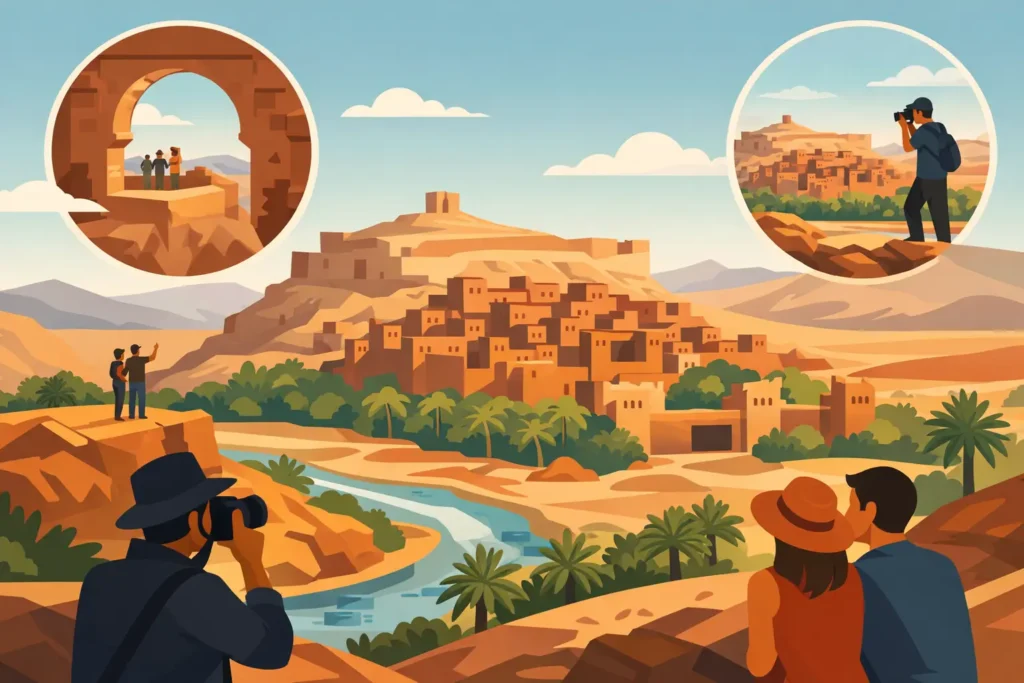
The best Ait Ben Haddou viewpoints are not all found at the same time of day, or from the same side of the river. This ancient fortified ksar changes character with the light: rose-gold at sunrise, richly textured in the afternoon and deeply dramatic as the sun drops behind the Atlas foothills. For travellers coming from Marrakech, Ouarzazate or the Sahara, a little planning turns a short stop into one of the most memorable photo moments of a Morocco holiday.
Ait Ben Haddou sits in the Ounila Valley, on the historic caravan route between the Sahara and Marrakech. Its clustered earthen houses, defensive walls and hilltop granary have made it one of Morocco’s most recognisable landscapes. It is also a working heritage site rather than a film set, so the best experience balances great photographs with respectful, unhurried exploration.
The Best Ait Ben Haddou Viewpoints
1. The riverbank facing the ksar
The classic full view comes from the open ground across the Ounila River. From here, the entire ksar rises in layers above the palms, with the hilltop agadir, or granary, forming the high point. This is the essential viewpoint for first-time visitors because it shows the scale and setting that can disappear once you are inside the narrow lanes.
In dry periods, you may cross the river using sandbags or a simple footbridge. After rain, water levels and crossings can change, so do not assume the usual route is available. Wear shoes with a good grip and ask locally which crossing is safest that day. Early morning is especially rewarding here, when the village is quiet and the façades begin to catch the sun.
2. The hilltop granary above the village
For the highest perspective, walk through the ksar and follow the path upwards towards the old granary. The climb is short but uneven, with loose earth, stone steps and sections that can be steep in warm weather. Take your time. From the top, you can look down over the maze of kasbah-style buildings, across the river valley and towards the road leading to Ouarzazate.
This is one of the best Ait Ben Haddou viewpoints for travellers who want more than the postcard shot. It reveals why the location was chosen: the settlement commands the valley, while its defensive position once helped protect trade routes and families. Mid-morning usually gives clearer detail across the roofs. At sunset, the atmosphere is beautiful, though low light can make the descent more difficult.
3. The upper lanes inside the ksar
Some of the strongest images at Ait Ben Haddou are close-up rather than panoramic. As you climb through the upper lanes, pause at openings between buildings and small terraces overlooking the valley. Framed views of mud-brick towers, wooden doors, palm groves and distant hills tell a more intimate story of the ksar.
These viewpoints depend on which homes and passageways are open at the time. A number of families still live in or maintain parts of the village, and some spaces are private or used as small cafés and guesthouses. Always ask before stepping onto a terrace, photographing people or entering a doorway. A local guide can help distinguish public paths from private areas and add context that is easy to miss when walking alone.
4. A rooftop terrace in the newer village
Across the river, the newer village has cafés and small guesthouses with elevated terraces facing the old ksar. This is the most comfortable option for couples, families and anyone who would prefer not to climb in midday heat. Order a mint tea, settle in and watch the light shift across the mud walls.
Terrace views are particularly useful during the middle of the day, when you may want shade and a rest before returning to explore. They are also a sensible choice for visitors with limited mobility. The view will be less elevated than the granary, but it has a relaxed, wide-angle quality and offers a clear sightline to the whole fortified village.
5. The approach road from Ouarzazate
As you arrive from Ouarzazate, there are broad roadside views of Ait Ben Haddou emerging beyond the river and palms. This approach is ideal for establishing photographs that place the ksar within its desert-edge landscape. It is not the place to stop casually on a bend or narrow shoulder, however. Use a safe pull-in point agreed with your driver, and never step into the road for a photograph.
The approach works best in late afternoon, when the earthen architecture becomes warmer in colour. If your itinerary includes the Skoura Oasis, Ouarzazate or the road towards the Dades Valley, this makes an easy first look before a longer visit on foot.
6. The palm grove path downstream
A quieter alternative lies along the paths beside the palms and cultivated fields downstream from the main crossing. Here, the ksar appears beyond reeds, greenery and the riverbed rather than in a direct frontal composition. It is a lovely choice for travellers who prefer landscape photography and a slower pace.
Conditions vary with the season. After rain, paths may be muddy, while summer heat can be intense with little shade beyond the palms. This is not usually the best place for a rushed stop, but it rewards visitors who have allowed enough time to walk, observe and photograph without following the busiest route.
7. Sunset from the opposite bank
Sunset is popular for good reason. As the direct sun softens, the towers and walls take on shades of copper, ochre and terracotta, while shadows bring out their handmade texture. The opposite bank gives the cleanest view for this final light, especially when the sky is clear.
There is a trade-off: sunset attracts more visitors, and the last light can disappear quickly behind the surrounding terrain. Arrive at least 30 to 45 minutes before sunset rather than turning up at the final moment. If you plan to climb to the granary, go earlier and be back down before paths become dark. A torch on your mobile phone is useful, but it should not replace sensible timing.
When to Visit for the Best Light
For photography, sunrise and the final two hours before sunset are usually the strongest times. Morning is cooler, quieter and often better for photographing the main façade from the riverbank. Late afternoon creates warmer colours and is convenient for travellers arriving from Marrakech or continuing towards Ouarzazate.
Midday is not wrong, particularly in winter, but the light can be harsh from late spring through early autumn. Use that time for lunch, a terrace view or close details in shaded lanes. In summer, carry water, a hat, sunscreen and footwear suitable for dusty, uneven ground. Morocco’s dry heat can feel stronger than expected when you are climbing exposed paths.
How Much Time Should You Allow?
Allow at least 90 minutes if you want the main riverbank view, a walk through the ksar and the climb to the granary. Two to three hours is better if you would like a relaxed lunch, palm-grove walk or time to wait for afternoon light. Travellers on a private route can build the stop around their own pace rather than trying to match a large coach group’s schedule.
From Ouarzazate, Ait Ben Haddou is roughly a 30-minute drive, making it straightforward as a half-day outing. From Marrakech, the journey commonly takes around four hours each way, depending on traffic, road conditions and stops across the High Atlas. Many guests prefer to include it on a multi-day route towards the Dades Valley, the Todra Gorge or Merzouga, where the journey feels part of the holiday rather than a long return drive.
A Better Way to Experience Ait Ben Haddou
A knowledgeable local driver-guide makes a real difference here. They can plan arrival around the light, choose a safe place to stop, explain the history behind the earthen architecture and adjust the day if weather or road conditions change. For private Morocco itineraries, Morocco Customized Tours can combine Ait Ben Haddou with the Atlas Mountains, Ouarzazate film studios, the Valley of the Roses or a Sahara desert expedition in a route designed around your interests.
Bring curiosity as well as a camera. The most rewarding viewpoint may be the famous panorama from across the river, but the lasting memory is often a quieter one: sunlight on a carved doorway, the sound of the wind above the rooftops, or the valley stretching beyond the old caravan stronghold.