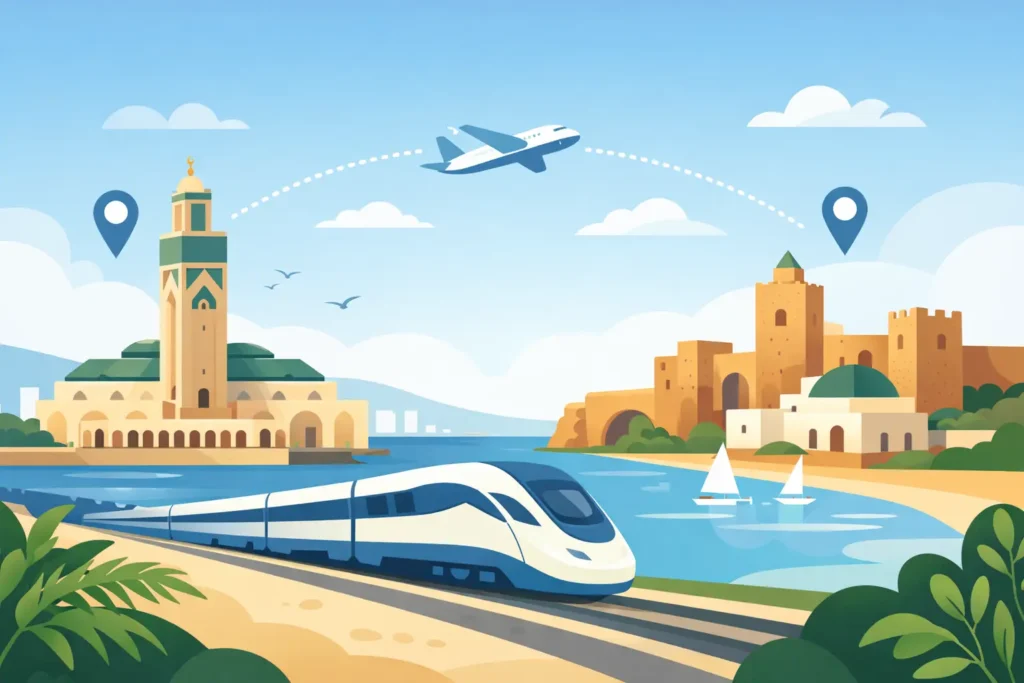
Rabat feels refreshingly different after the energy, traffic and grand scale of Casablanca. On a Casablanca to Rabat day trip, you can move from Morocco’s commercial capital to its calm political and royal capital in little more than an hour, trading busy boulevards for Atlantic views, elegant gardens, ancient walls and some of the country’s most important monuments.
For travellers based in Casablanca, this is one of the most rewarding day trips in northern Morocco. Rabat is compact enough to enjoy without rushing, yet layered enough to reveal Roman history, Andalusian influence, royal heritage and everyday Moroccan life. A private driver and local guide make the day especially easy: transport is organised, timings are flexible, and you can spend more time in the places that genuinely interest you.
Why Rabat is worth the journey from Casablanca
Rabat is a UNESCO-listed capital, but it does not feel like a museum city. Government buildings, embassies and royal sites sit alongside lived-in medina lanes, traditional cafés and families gathering near the river at sunset. Its atmosphere is more relaxed than Casablanca and less intense than Marrakech or Fes, which makes it a good choice for couples, families and first-time visitors who want meaningful sightseeing at a comfortable pace.
The route is straightforward. Rabat lies roughly 90 kilometres north of Casablanca along the Atlantic corridor. A private journey usually takes around 1 hour 15 minutes to 1 hour 30 minutes each way, depending on your hotel location and city traffic. Leaving Casablanca early gives you a full day in Rabat and avoids the busiest part of the morning departure.
You can travel independently by train, and it is a practical option for confident travellers who are happy to arrange taxis and navigation at both ends. However, a private day trip is often better value for small groups or families. It removes the need to coordinate transfers, wait for taxis between monuments, or work out which sites are open on the day. It also gives you the freedom to adjust the route if you want a longer lunch, extra time for photographs or a stop at Chellah.
A Casablanca to Rabat day trip itinerary
A well-planned day normally begins with collection from your Casablanca hotel, riad or cruise terminal. Most private departures leave between 8.00 and 9.00 am. Your driver heads north towards Rabat, with the day arranged around your preferred pace rather than a fixed coach schedule.
Hassan Tower and the Mausoleum of Mohammed V
The strongest first stop is usually the Hassan Tower, Rabat’s most recognisable landmark. The 12th-century minaret was intended to be part of an immense mosque, though construction stopped when Sultan Yacoub al-Mansour died. What remains is striking: the sandstone tower rises above a vast open courtyard filled with rows of unfinished columns.
Across from the tower stands the Mausoleum of Mohammed V, one of Morocco’s most respected national monuments. Its white marble exterior, green tiled roof and finely carved details show the craft traditions that define Moroccan architecture. Visitors can look down into the central chamber from the surrounding gallery, where the tomb of King Mohammed V is guarded by ceremonial soldiers.
This area is spacious and easy to explore, making it a comfortable start for families and travellers with limited mobility. Morning light is especially good for photographs, before the site becomes busier.
Kasbah of the Udayas and the Atlantic coast
From Hassan Tower, continue to the Kasbah of the Udayas, a fortified quarter above the Bouregreg River. Its white-and-blue painted lanes are often compared with coastal Andalusian towns, but the kasbah has its own character: heavy stone gates, quiet homes, flower-filled corners and views across the river towards Salé.
This is one of the best places to slow down. Walk through Bab Oudaia, pause at the traditional Moorish café, and look out towards the Atlantic where the river meets the sea. The nearby Andalusian Garden offers shade and a peaceful break from the midday sun.
The kasbah’s steep, narrow lanes can be uneven, so comfortable walking shoes are helpful. If anyone in your group prefers less walking, your driver can drop you close to the main entrance and keep the visit short without missing the atmosphere of the site.
Rabat Medina and a local lunch
Rabat’s medina is smaller and calmer than the medinas of Fes and Marrakech. That is exactly its appeal. You can browse shops selling leather goods, ceramics, spices, slippers and woven textiles without feeling pressured to hurry through crowded alleyways.
A local guide adds real value here, particularly if you would like to understand the products you are seeing or find a reliable place for lunch. Depending on your tastes, lunch can be simple and traditional – perhaps grilled fish, tagine or couscous – or more refined at a restaurant overlooking the river or near the city centre. Moroccan couscous is traditionally served on Fridays, so menus may differ on other days.
Allow enough time to enjoy the meal. Trying to fit every monument into one day can make Rabat feel like a checklist. A private itinerary works best when it leaves space for a relaxed lunch and a little unplanned wandering.
Chellah: the optional historic stop
If you enjoy archaeology, gardens and quieter historic places, Chellah deserves a place in your itinerary. This walled site combines Roman ruins with the remains of a medieval Islamic necropolis. Stone roads, old columns, carved gates and nesting storks create a setting that feels very different from Rabat’s formal royal monuments.
Chellah is not essential if this is your first day trip and you would rather spend longer in the kasbah and medina. But for history lovers, photographers and repeat visitors to Morocco, it is often the day’s most memorable stop. Ask your driver or guide to check opening arrangements before departure, as site access and hours can change.
How long should you allow?
For most travellers, a nine- to ten-hour private excursion is ideal. That includes the return drive, the principal sights, lunch and free time. A typical day may see you back in Casablanca between 5.30 and 7.00 pm, depending on traffic and whether you include Chellah.
A shorter six- or seven-hour trip is possible, but it requires choices. In that case, focus on Hassan Tower, the Mausoleum of Mohammed V, the Kasbah of the Udayas and a brief medina walk. Skipping a sit-down lunch or Chellah will keep the schedule comfortable.
If you are continuing onwards to Tangier, Fes or Chefchaouen, Rabat can also work as a stop between cities rather than a return day trip. This is a smart option for travellers who want to see more of Morocco without repeating the same road journey.
What to know before you go
Rabat is pleasant throughout much of the year. Spring and autumn offer mild temperatures for walking, while summer is generally cooler than inland cities thanks to the Atlantic breeze. Even so, midday sun can be strong, so bring water, sunglasses, sunscreen and a light layer for breezy coastal viewpoints.
Dress modestly for a respectful and comfortable visit, particularly around the mausoleum and in older neighbourhoods. Lightweight clothing that covers shoulders and knees is a sensible choice. Shoes should be suitable for cobbles, steps and uneven surfaces at the kasbah or Chellah.
Friday is an important day of prayer in Morocco. Some businesses may open later, and local rhythms can be quieter around lunchtime. Your itinerary can still run well on a Friday, but it is worth allowing flexibility. National holidays, royal events and official ceremonies may also affect access around government and royal areas.
A guided private service is particularly useful for cruise passengers arriving in Casablanca. Pick-up times can be built around your ship schedule, and the route can be shortened if you need to return to port at a fixed hour. For hotel guests, the same flexibility means you can tailor the day around children, mobility needs, shopping interests or a preference for food and architecture.
Make the day feel personal
The best Casablanca to Rabat day trip is not about collecting monuments. It is about seeing how Morocco’s capital works beyond the postcard views: the guards outside the mausoleum, fishermen near the river, families in the gardens and craftspeople in the medina.
At Morocco Customized Tours, our Moroccan-born drivers and guides can shape the route around what matters to you, whether that means more history at Chellah, more time by the Atlantic, a carefully chosen lunch or a gentle pace for the whole family. Leave Casablanca with an open schedule, and let Rabat show you its quieter, confident side.