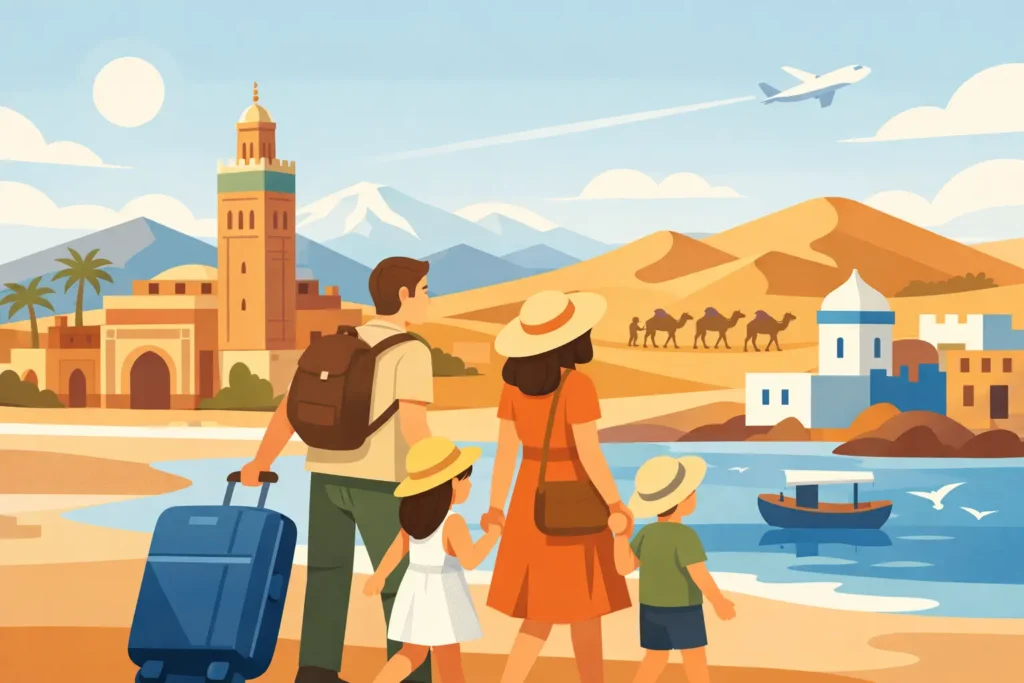
A well-planned family trip to Morocco can bring camel rides at sunset, colourful souks, mountain villages and time by the pool into one memorable holiday. This Morocco family holiday guide is designed for parents who want the country’s big experiences without exhausting travel days, confusing logistics or constant packing and unpacking.
Morocco works especially well for families when the route is private and paced around your children’s ages. A dedicated driver-guide can adjust stops, arrange suitable hotels and turn a long drive into part of the adventure, with viewpoints, lunch breaks and short walks along the way.
Choose the right length for your family holiday in Morocco
For a first visit, allow at least seven nights. This gives your family enough time to experience Marrakech, travel through the Atlas Mountains and spend a night in the Sahara without making every day a transfer day. Ten to twelve nights is more comfortable if you also want Fes, Chefchaouen or time on the coast.
A shorter five- or six-night itinerary can work for families flying into Marrakech, particularly if your priority is the desert. In that case, avoid trying to add northern Morocco as well. Distances are greater than they appear on a map, and children generally enjoy two excellent destinations more than four rushed ones.
For younger children, build in two-night stays where possible. Marrakech is a good place to begin because families can settle after the flight, enjoy a relaxed first day and adjust to the atmosphere before heading into the mountains or desert.
A family-friendly Morocco route from Marrakech
The most popular private route combines Marrakech, Ait Ben Haddou, the Dades Valley and Merzouga. It offers a varied look at Morocco while keeping the journey logical.
Days 1 to 3: Marrakech at a gentle pace
Marrakech can be exciting, noisy and wonderfully sensory, so it is best explored in manageable pieces. A private guided walk through the medina helps families avoid getting lost in the maze of lanes and gives children context for what they are seeing, from spice stalls to artisans at work.
Choose one main activity each day rather than filling the schedule. A morning visit to a palace or garden, followed by pool time at your riad or hotel, is often more enjoyable than a full day of sightseeing. In the evening, Jemaa el-Fna is lively and memorable, but keep younger children close and visit early before the square becomes busiest.
Family-friendly stays in Marrakech should have a reliable pool, spacious rooms or interconnecting options, and easy vehicle access. A beautiful riad deep inside the medina may suit some families, while others prefer a hotel with gardens just outside the old city. There is no single right choice – it depends on whether your priority is atmosphere, space or downtime.
Days 4 to 5: Atlas Mountains and kasbah country
Your private journey south crosses the High Atlas via the Tizi n’Tichka pass, with wide views and frequent opportunities to stop. The road is winding, so take it steadily, especially if anyone is prone to travel sickness. Your driver can plan regular breaks and choose a comfortable lunch stop.
Ait Ben Haddou is a highlight for children who like stories, film locations and climbing through historic mud-brick lanes. The climb to the upper viewpoint is optional, but the lower paths still offer plenty to see. From here, continue towards the Dades Valley or nearby Skoura, where palm groves and kasbahs provide a quieter contrast to Marrakech.
This section of the route is ideal for a family hotel with a garden or pool. After a few hours in the vehicle, a place where children can run around matters more than a packed afternoon programme.
Days 6 to 7: Merzouga and the Sahara Desert
Merzouga is where the landscape changes dramatically. Families can meet camels near the dunes, watch the light change at sunset and sleep in a comfortable desert camp. For many children, this is the moment they remember most clearly.
Camel trekking is not essential for everyone. Small children, nervous riders or family members with back concerns may prefer a short camel experience followed by a 4×4 transfer to camp. A private itinerary gives you that choice. The goal is not to tick a box, but to make the desert feel enjoyable and safe for every member of the family.
Select a camp with private tents, proper beds, en-suite facilities where possible and a clear approach to evening meals. Desert temperatures can change sharply after sunset, even in warmer months, so bring layers for everyone. Sandals are useful around camp, but closed shoes are better for exploring dunes.
When to visit Morocco with children
Spring, from March to May, and autumn, from September to November, are usually the easiest periods for a Morocco family holiday. Days are generally pleasant for city visits, mountain travel and the desert, although weather in the Atlas can still vary.
Summer holidays can work well if you plan carefully. Marrakech and the Sahara can become very hot from June to August, so choose early starts, air-conditioned transport, accommodation with pools and less time outdoors in the middle of the day. Families travelling in summer may prefer to add Essaouira or another Atlantic coast stop, where the breeze is often cooler.
Winter brings clear desert skies and fewer crowds, but evenings are cold, particularly in the mountains and Sahara. It is a lovely season for families who are prepared with warm layers and do not expect pool weather every day.
Practical details that make travelling easier
Private transport is the simplest way to travel between Morocco’s major attractions with children. It removes the need to negotiate train times, taxi prices and luggage transfers, while allowing for toilet stops and unplanned pauses. For longer routes, a comfortable vehicle with strong air conditioning is worth prioritising.
Moroccan food is varied and can be very family-friendly. Tagines, grilled chicken, couscous, omelettes, fresh bread and fruit are widely available. Let your guide or driver know about allergies, vegetarian requirements or picky eaters before departure so restaurants and hotels can prepare. In busy medinas, bottled water is sensible, and hand sanitiser is useful before meals.
Pack light layers, sun hats, sun cream, a small first-aid kit and familiar snacks for transfer days. Bring a reusable water bottle, but use safe drinking water to refill it. If your child needs a car seat, request it while planning the itinerary rather than assuming one will be available locally.
What families should know about safety and culture
Morocco is welcoming to families, and children often receive warm attention from local people. As in any busy destination, parents should keep an eye on belongings in crowded squares and markets. A private local guide is particularly valuable in Marrakech and Fes, where medina lanes can be busy and disorientating.
Dress does not need to be overly formal, but modest, breathable clothing is a respectful and practical choice when visiting religious areas and rural communities. Mosques are generally not open to non-Muslim visitors, with a few exceptions, so your guide can suggest meaningful alternatives such as madrasas, palaces, gardens and artisan workshops.
Be realistic about energy levels. A child who has spent the morning bargaining for a souvenir, climbing a kasbah and tasting fresh orange juice has already had a full cultural day. Leave room for a swim, a quiet drive or an early dinner.
Make the itinerary fit your family, not the other way round
The best Morocco family holiday is rarely the one with the longest list of stops. It is the one that matches your children’s ages, your preferred hotel style and your comfort with road travel. Some families want desert adventure and boutique riads; others want larger hotels, shorter drives and several pool afternoons.
Morocco Customised Tours can tailor private routes around those priorities, with Moroccan guides, multilingual support and on-the-ground coordination from arrival to departure. Whether you start in Marrakech, Fes, Casablanca or Tangier, the route should feel considered rather than fixed.
Give your family time to pause when something catches their attention – a roadside fossil stall, a mountain tea stop, a musician in the square or the first sight of the dunes. Those unhurried moments often become the stories everyone tells long after the holiday ends.