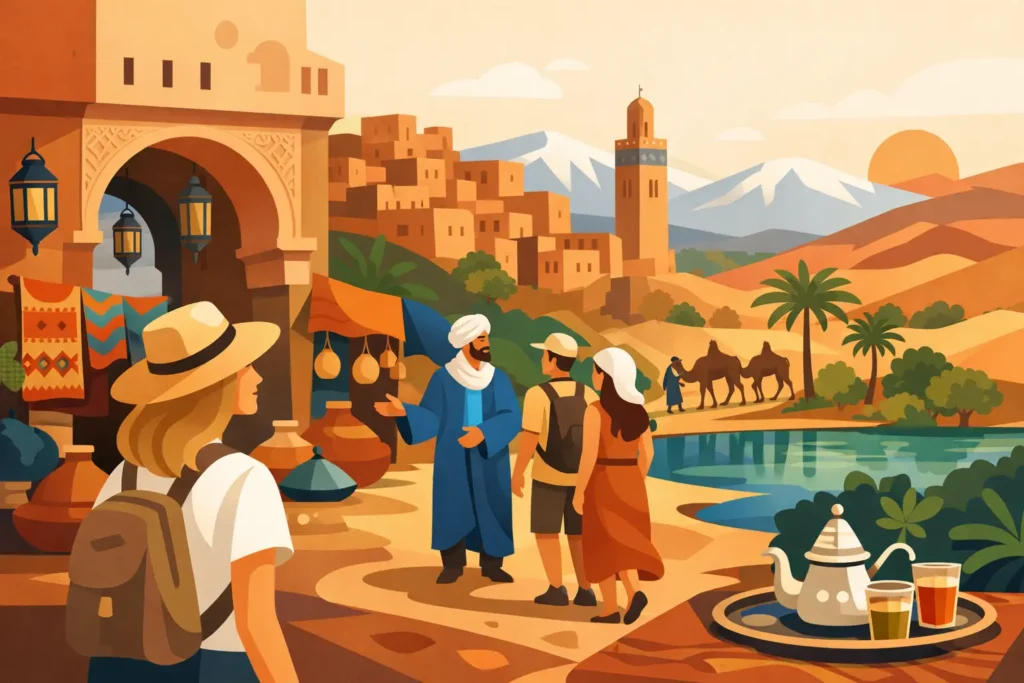
You can see Morocco from a car window and still miss the country completely. The difference with Morocco cultural immersion tours is not simply where you go, but how you experience each place – with time for local conversation, regional food, family traditions, and guides who know what sits beyond the standard photo stop.
For many travellers, Morocco is a first big trip into North Africa, and there is a lot to balance. You want the famous places – Marrakech, Fes, Chefchaouen, Merzouga, the Atlas Mountains – but you also want the trip to feel personal rather than rushed. That is where a well-designed private cultural itinerary matters. It gives you structure, comfort and reliable logistics, while still creating space for the moments people remember most.
What Morocco cultural immersion tours should actually include
A true cultural tour of Morocco should go further than ticking off monuments. Of course, the medinas, palaces and desert camps matter. But cultural immersion happens when those headline destinations are paired with real local context.
That can mean walking through the old quarters with a Moroccan-born guide who explains daily life, not just architectural dates. It can mean sharing mint tea in a village near the Atlas Mountains, visiting a local market where people actually shop, or learning why food, music and craftsmanship change so much from one region to the next. Morocco is not culturally uniform, and a strong itinerary should reflect that.
Private touring also makes a noticeable difference. In a group coach setting, schedules tend to be fixed and interactions often stay surface level. On a private journey, you can slow down in a medina, spend more time with artisans, or add experiences that suit your interests, whether that is cooking, architecture, textiles, Amazigh heritage or desert life.
Why private cultural travel works better in Morocco
Morocco rewards travellers who have local support. The country is welcoming and exciting, but it can also feel intense for first-time visitors, especially in busy old cities. A private driver and guide remove the stress from transfers, navigation and timing, leaving you free to focus on the experience itself.
There is also a practical side to cultural immersion. Some of the most rewarding experiences are not obvious when you are planning from abroad. You may not know which riad is best placed for a quieter stay, which rural road offers the better mountain route, or how to combine Fes and the Sahara without making the journey exhausting. Local operators can shape the trip around comfort as well as authenticity.
That balance matters. Some travellers want a more active and in-depth route with village walks and hands-on experiences. Others want cultural access, but with luxury accommodation, a dedicated driver and slower pacing. Neither approach is more valid than the other. The best tours are the ones tailored to how you like to travel.
The best routes for Morocco cultural immersion tours
If your time is limited, the most effective itineraries usually begin from Marrakech, Fes, Casablanca or Tangier. Each entry point gives a different rhythm to the journey.
Marrakech and the Atlas Mountains
Starting in Marrakech works well if you want an energetic beginning followed by contrast. The city itself is full of craft traditions, historic architecture, gardens and food culture. But the immersion becomes deeper when you leave the city for the High Atlas, where village life, mountain landscapes and Amazigh hospitality give the trip a very different tone.
A route that combines Marrakech, Ait Ben Haddou, Ouarzazate and the Dades or Todra region adds both heritage and scenery before continuing to the Sahara. This is one of the most popular cultural circuits because it mixes imperial history, kasbah architecture, local farming communities and desert experience in one journey.
Fes and the Sahara
Fes is often the strongest starting point for travellers interested in Morocco’s intellectual, spiritual and artisan traditions. The old city has depth, and with the right guide it becomes far more than a maze of lanes. You begin to understand how the medina still functions as a living urban centre rather than a historic backdrop.
From Fes, travelling south towards Ifrane, the cedar forests, the Ziz Valley and Merzouga shows another side of the country. This route suits travellers who want to feel regional change clearly – from the northern cultural heartland to oasis towns and the edge of the dunes.
Tangier, Chefchaouen and the north
Northern routes offer a softer pace and are ideal for visitors who prefer a blend of coastal atmosphere, mountain scenery and smaller-scale cultural stops. Tangier brings international history and a distinct identity shaped by Europe, Africa and the Mediterranean. Chefchaouen adds visual charm, but the real value lies in using it as part of a broader northern itinerary rather than treating it as a single overnight photo destination.
What makes a tour feel immersive rather than staged
This is where itinerary design matters most. Some activities look cultural on paper but feel performative in real life. Others are simple, quiet and completely memorable.
An immersive experience usually includes time in places where daily life is still unfolding around you. That may be an early market visit, a bread oven in a village, a conversation with a local artisan, or a drive through date palm valleys with stops chosen by someone who knows the region well. It feels natural, not forced.
Accommodation also changes the tone of a trip. Riads, kasbah-style guesthouses and carefully selected desert camps often create more connection than anonymous hotels. That does not mean sacrificing comfort. In fact, many travellers prefer a cultural tour with premium stays, because they want authenticity during the day and a high standard of rest at night.
Food is another part of the experience that should not be treated as an afterthought. Moroccan cuisine varies by region, and a good tour should make room for that. Street food in one city, a home-style lunch in another, and a more refined dining experience elsewhere can all belong in the same itinerary.
Who Morocco cultural immersion tours suit best
These tours work especially well for couples, families, private friendship groups and first-time visitors who want more than a checklist holiday. They are also ideal for travellers who value reassurance. Morocco is easy to enjoy when transport, timings and local guidance are handled properly.
For families, a private route allows flexibility around pace and stops. For couples, it creates a more personal atmosphere, especially in the desert, in mountain guesthouses or in carefully chosen riads. For older travellers or premium clients, private touring offers comfort and consistency without removing the local character of the trip.
The main trade-off is budget. Cultural immersion tours with private service cost more than joining a basic group departure. But in return, you get a tailored route, direct support, more meaningful access and a smoother overall journey. For many visitors, that difference is worth it.
Choosing the right operator for a cultural tour of Morocco
Not every company offering cultural trips delivers the same depth. The key is to look for local ownership, guides with genuine regional knowledge and itineraries that can be adapted to your interests. A fixed package can be useful as a starting point, but the best results usually come when the route is adjusted around what you want to see and how you want to travel.
Ask practical questions. Who will meet you on arrival? Is the tour private from start to finish? Can the company tailor the number of nights in each stop? Are desert camps, local guides and accommodation standards clearly explained? These details affect the quality of the experience far more than polished sales language.
A strong operator should also be honest about distances and pacing. Morocco looks compact on a map, but travel days can be long. A well-planned trip does not try to do everything. It chooses the right route for your timeframe and makes each stop count. That is the approach taken by Morocco Customised Tours, where private service and local knowledge are built into the planning from the start.
How long to travel for a meaningful experience
If you want a journey that feels immersive rather than rushed, 7 to 10 days is usually the minimum sweet spot. That gives you enough time to combine one major city with the desert and at least one mountain or rural region. If you have 12 to 14 days, the experience becomes richer still, with room for Marrakech, Fes, Chefchaouen or the coast in one coherent route.
Shorter tours can still work, particularly from Marrakech or Fes, but they need focus. Trying to fit every famous destination into five days often weakens the cultural side of the trip. Slower travel nearly always produces better memories in Morocco.
The best Morocco cultural immersion tours do not try to impress you with volume. They give you the country in layers – its cities, landscapes, traditions and people – with enough comfort that you can enjoy it all properly. If you choose the right route and the right local team, Morocco stops feeling like a place you are passing through and starts feeling like a place you truly met.
When your itinerary is built around real access, sensible pacing and local guidance, the journey stays with you long after the flight home.