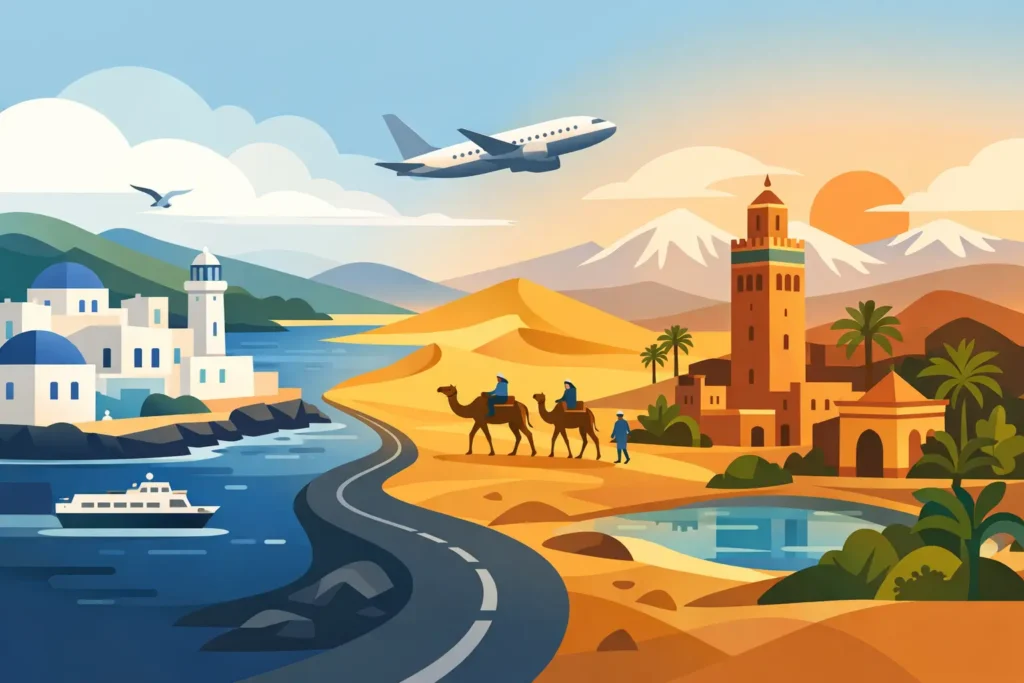
Landing in Tangier and finishing in Marrakech gives you one of Morocco’s most rewarding cross-country routes. An 8 days Tangier to Marrakech trip lets you move from the Mediterranean north to the imperial cities, through the desert and Atlas landscapes, and into the country’s most famous southern city without feeling rushed at every stop.
For many travellers, the real question is not whether this route is worth doing, but how to organise it well. Distances in Morocco can be longer than they first appear on a map, and the difference between a tiring circuit and a memorable holiday usually comes down to pacing, local guidance and where you choose to spend your nights. This itinerary works best as a private tour, especially if you want comfort, flexibility and time to enjoy the places in between.
Why choose an 8 days Tangier to Marrakech route?
This route suits first-time visitors who want to see Morocco’s best-known highlights in a single journey. Starting in Tangier gives you a northern gateway with international access, while ending in Marrakech places you in a city that is ideal for a final stay, onward flights or extra days after the tour.
What makes this itinerary attractive is its range. You can include Tangier’s coastal character, the blue lanes of Chefchaouen, the cultural depth of Fes, the Sahara near Merzouga, the Todra Gorges, Ouarzazate, Ait Ben Haddou and the High Atlas before arriving in Marrakech. That is a broad sweep of the country in eight days, but it is still manageable when the route is planned properly.
The trade-off is simple. You will cover a lot of ground, so this is not the right trip for travellers who want long stays in each city. It is designed for those who prefer a well-paced touring holiday with strong variety rather than a slow, single-region escape.
Recommended 8 days Tangier to Marrakech itinerary
Day 1 – Tangier arrival and transfer to Chefchaouen
After arrival in Tangier, most travellers benefit from heading directly towards Chefchaouen rather than staying overnight in the city. Tangier is interesting, but on an 8-day schedule, Chefchaouen usually offers a more memorable first night. The drive introduces you to northern Morocco’s green hills and Rif landscapes.
By the afternoon or evening, you can settle into Chefchaouen’s medina, known for its blue-painted streets, mountain setting and relaxed atmosphere. It is a gentle start to the trip and a good place to recover from travel.
Day 2 – Chefchaouen to Fes
A morning in Chefchaouen allows time for photographs, quiet walks through the old town and a slower breakfast before continuing south. From there, the journey to Fes takes you into one of Morocco’s most important historical and spiritual centres.
Arriving in Fes, it is worth staying in a well-located riad where the atmosphere feels traditional but the comfort is reliable. This matters more than many visitors expect, especially after a road transfer.
Day 3 – Guided visit of Fes
Fes deserves a proper guided day. Its medina is not a place most visitors enjoy navigating alone on a first visit, and local guidance turns a confusing maze into a meaningful cultural experience. You can expect to see historic madrasas, artisan quarters, traditional tanneries and the layers of old and new city life that make Fes so distinctive.
This is also where a private itinerary adds real value. You can adjust the pace, spend longer at the places that interest you most and avoid the feeling of being pushed through a standard group schedule.
Day 4 – Fes to Merzouga Desert
This is one of the longer driving days, but it is also one of the most dramatic. Leaving Fes, the route passes through Ifrane, cedar forests near Azrou and the changing landscapes of the Middle Atlas. As you move south-east, the scenery becomes more open and increasingly desert-like.
By the time you reach Merzouga, the atmosphere changes completely. Here, the dunes of Erg Chebbi create the classic Sahara experience many travellers imagine when planning Morocco. Depending on the season and your arrival time, you may head into the dunes by camel or 4×4 for a camp stay under the stars.
Day 5 – Merzouga to Todra Gorges or Dades Valley
A desert sunrise is usually one of the strongest memories of this route. After breakfast, the journey continues west through desert towns and oasis landscapes towards the Todra Gorges or Dades Valley.
This section balances the previous long drive with a more scenic and varied day. You pass palm groves, kasbah country and striking rock formations. Overnighting in the gorges or valley breaks up the route well and keeps the journey comfortable.
Day 6 – Dades or Todra to Ouarzazate via Ait Ben Haddou
Today brings you into southern Morocco’s cinematic and historic landscapes. Ouarzazate is often called the gateway to the desert, but the real highlight for many visitors is Ait Ben Haddou, the fortified ksar known for its earthen architecture and dramatic hilltop setting.
This stop is more than a photo opportunity. With time to walk through the site and understand its history, you get a better sense of Morocco’s caravan routes and pre-modern building traditions. Overnight in Ouarzazate or nearby keeps the final day to Marrakech easier.
Day 7 – Ouarzazate to Marrakech عبر the High Atlas
The drive to Marrakech via the Tizi n’Tichka Pass is one of the most beautiful road journeys in the country. Mountain villages, changing colours in the rock and broad valley views make this final transfer feel like part of the experience rather than just transport.
On arrival in Marrakech, the mood shifts again. After days of smaller towns and open landscapes, the city feels energetic, theatrical and full of contrast. A good riad in the medina or a comfortable hotel just outside the old city depends on your style of travel. Some guests want to step straight into the souks, while others prefer a calmer base with easier vehicle access.
Day 8 – Marrakech guided visit and departure
Your last day is best used for a guided visit of Marrakech before departure, especially if your flight is later in the day or if you are extending your stay. Highlights often include the Koutoubia area, Bahia Palace, the Saadian Tombs, the souks and Jemaa el-Fnaa.
If you have already spent time in busy cities elsewhere on the trip, this final day can be tailored. Some travellers prefer gardens, architecture and a slower pace, while others want the full medina experience before heading home.
What this itinerary includes well – and where flexibility helps
An 8 days Tangier to Marrakech tour covers a remarkable amount of Morocco, but success depends on realistic expectations. You will see the country’s major contrasts, yet each stop is necessarily selective. You are not “doing everything”, and that is exactly why itinerary design matters.
Chefchaouen is often the first place people ask to add, and for good reason. It breaks up the north nicely. Still, if your priority is deeper time in Fes or Marrakech, some travellers choose to reduce time in Chefchaouen or make Tangier itself a fuller first day. Families with children sometimes prefer fewer hotel changes, while couples on a first Morocco holiday often want the broadest scenic variety possible.
Desert camp selection also matters. Not every camp offers the same level of comfort, privacy or service. Standard camps can be perfectly suitable for some travellers, but luxury camps are usually the better choice for those who value private bathrooms, stronger bedding and a more polished experience. This is one area where price differences genuinely reflect comfort.
Is private travel better for this route?
For this specific journey, private travel is usually the best fit. The route is long, the stops are varied, and the quality of the experience improves significantly when your transport, timing and hotel choices are coordinated by people who know the road conditions and seasonal patterns.
A private driver-guide means fewer compromises. You can stop for views, change the lunch timing, adapt to weather and move at your own pace. It also makes arrival and departure days much easier, particularly if you are entering Morocco for the first time and want reassurance from the moment you land.
This is where a locally run operator has a clear advantage. With on-the-ground knowledge, multilingual support and access to trusted riads, camps and regional guides, the trip feels smoother and more personal. Morocco Customised Tours builds these routes around exactly that kind of practical comfort.
Best time to book 8 days from Tangier to Marrakech
Spring and autumn are generally the most balanced seasons for this route. Temperatures are more comfortable in the north, the cities and the Sahara, and road travel tends to be easier overall. Summer can still work, but the desert portion is much hotter, so early starts and stronger hotel choices become more important. Winter offers beautiful light and fewer crowds, though nights in the desert can be very cold.
The right season depends on what matters most to you. If you want greener landscapes in the north, spring has an advantage. If your focus is photography and clear desert skies, autumn and winter can be excellent.
Who this trip is best for
This itinerary works especially well for couples, private groups and first-time visitors who want a structured overview of Morocco without trying to plan every transfer themselves. It is also a strong option for travellers arriving in northern Morocco and wanting to finish in the south without backtracking.
If you prefer very slow travel, there may be better alternatives, such as focusing only on the north or combining Marrakech with the desert and Atlas region. But if your goal is to see Morocco’s major highlights in one coherent route, eight days from Tangier to Marrakech is one of the most complete journeys you can choose.
The best version of this trip is never just about ticking off destinations. It is about moving through Morocco with the right pace, the right local support and enough flexibility to make the country feel welcoming rather than overwhelming.