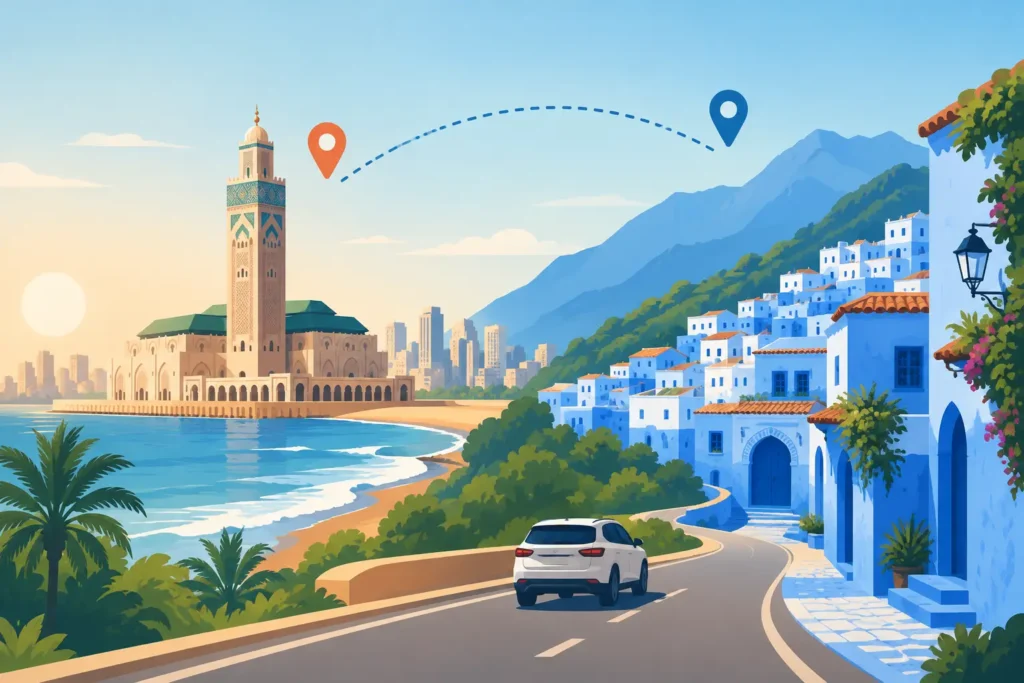
A Casablanca to Chefchaouen itinerary is one of the most rewarding short routes in northern Morocco, but it works best when you do not rush it. The distance between the Atlantic coast and the Rif Mountains is considerable, and the journey becomes far more memorable when you include Rabat, Meknes or Volubilis along the way. With a private driver-guide, you can enjoy Morocco’s major landmarks, local food and changing landscapes without the pressure of navigating timetables or changing buses.
For most travellers, three days is the right balance. It allows time for Casablanca’s architectural highlights, a comfortable night in Rabat or Meknes, and a full afternoon and evening in Chefchaouen. If your holiday allows four days, you can travel more slowly and add extra time in the blue city.
Why take three days from Casablanca to Chefchaouen?
Chefchaouen is roughly 330 kilometres from Casablanca by road, depending on the route and stops. Driving directly can take five to six hours, yet that option misses much of what makes northern Morocco special. Rabat, Morocco’s capital, is on the natural route, while the Roman ruins of Volubilis and imperial Meknes make a worthwhile inland detour.
A three-day journey also gives you flexibility. Couples may prefer boutique riads and long lunches; families may want shorter driving stretches and more room to explore. A private tour can be tailored around your flight arrival, hotel standard, dietary needs and preferred pace. This is particularly useful if Casablanca is your entry point but Chefchaouen is the destination you have been most looking forward to.
Day 1: Casablanca to Rabat
Begin in Casablanca with the Hassan II Mosque, one of Morocco’s most impressive modern landmarks. Its dramatic position beside the Atlantic and finely detailed craftsmanship make it a strong first introduction to the country. Non-Muslim visitors can usually enter as part of a guided visit at scheduled times, so planning the morning carefully is worthwhile.
Afterwards, drive north to Rabat, usually taking around one and a half hours. Morocco’s capital feels calmer than Casablanca, with broad boulevards, Atlantic light and important historic sites close together. Visit the Hassan Tower and the Mausoleum of Mohammed V, then continue to the Kasbah of the Udayas. Its white-and-blue lanes, gardens and river views offer a gentle preview of the colours waiting in Chefchaouen.
Spend the night in Rabat. This makes the next day manageable and gives you a more relaxed start than attempting the full Casablanca-to-Chefchaouen drive in one go. Travellers with a later arrival in Casablanca can reverse the emphasis: see the mosque if timings permit, then continue straight to Rabat for dinner and an overnight stay.
Where to stay in Rabat
Choose a riad in or near the medina if you want character and easy access to the old city, or select a modern hotel for larger rooms and straightforward parking. Both work well for a private itinerary. Your driver can collect you directly after breakfast, so there is no need to move luggage through unfamiliar streets.
Day 2: Rabat, Meknes and Volubilis to Chefchaouen
Leave Rabat after breakfast and head inland towards Meknes. Once a powerful imperial capital, Meknes has a more lived-in atmosphere than some of Morocco’s larger cities. Depending on restoration work and opening arrangements, your guide may show you monumental gates, the old royal granaries and the historic medina before continuing towards Volubilis.
Volubilis is Morocco’s best-known Roman archaeological site. Set among rolling fields, it offers a striking contrast to the dense medinas of the cities. You can walk along ancient streets and see surviving mosaics, arches and public buildings, while the nearby holy town of Moulay Idriss comes into view across the hills. Allow enough time to appreciate the site rather than treating it as a quick photograph stop.
From Volubilis, the road turns north towards the Rif Mountains. This final stretch to Chefchaouen generally takes around three hours, with scenery becoming greener and more mountainous as you approach. Arrive in the late afternoon, check into your riad, and take an unhurried first walk through the medina.
Chefchaouen is at its most atmospheric around sunset, when the blue-painted walls soften in the changing light and day visitors begin to leave. Have dinner on a rooftop terrace or in a small local restaurant, then enjoy the quieter lanes after dark. The medina is compact, but it has steps, uneven surfaces and many tempting side streets, so comfortable shoes matter more than formal evening wear.
Day 3: A full morning in Chefchaouen
Start early, before the main lanes become busy. Chefchaouen is famous for its painted blue buildings, but its appeal is not simply visual. It is a mountain town with Andalusian influence, a relaxed rhythm and residents going about their daily routines. A knowledgeable local guide can help you understand the medina’s history and find lesser-known corners while respecting the fact that people live here.
Walk through Plaza Uta el-Hammam, the heart of the old town, where cafés face the kasbah and grand mosque. Browse small shops for woven blankets, handmade soaps, ceramics and local crafts, but allow time to wander without a fixed agenda too. The most photographed stairways are often only a few minutes from the square, yet the quieter residential lanes are usually more rewarding.
For a view over the rooftops, take the short uphill walk to the Spanish Mosque in the late afternoon if your onward travel is not until evening. The climb is moderate rather than difficult, but the route can be warm in summer and slippery after rain. From the top, Chefchaouen’s blue medina appears nestled against the mountains – a fitting final view of northern Morocco.
If you need to continue to Fes, Tangier or Casablanca on day three, leave after lunch rather than rushing away in the morning. Tangier is the simplest onward route, usually around two and a half to three hours by road. Fes requires a longer journey of approximately four hours, while returning to Casablanca can take five to six hours. For an international flight from Casablanca, staying one final night near the airport is the safer choice.
Can you do Casablanca to Chefchaouen in two days?
Yes, but it is a faster itinerary. On the first day, visit Casablanca briefly and drive through Rabat before overnighting in Chefchaouen. On day two, explore the blue city and either continue to Tangier or begin the return journey. This suits travellers with limited time, but you will need to choose between a deeper visit to Rabat and stops at Meknes and Volubilis.
A two-day route is also more tiring for families with young children or anyone arriving on an overnight flight. In that case, the three-day plan is better value because it turns transfer time into part of the holiday rather than something to endure.
Practical planning for this route
The best seasons are spring and autumn, when temperatures are comfortable for city walks and mountain viewpoints. Summer brings hotter conditions in Casablanca and Rabat, although Chefchaouen can feel cooler in the evenings. Winter can be peaceful and beautifully green in the Rif, but rain is more likely and mountain roads may require extra care.
Chefchaouen’s medina is largely pedestrian, so your vehicle will stop outside or near an accessible gate. A good riad team can arrange help with bags, especially if your accommodation is up a slope. Pack layers for evenings, walking shoes with grip, and a small day bag for the medina.
Independent travel is possible, but public transport makes this route less flexible. You will need to coordinate station transfers, bus departure times and luggage in several places. Private transport costs more, but it gives you door-to-door travel, a reliable pace and the freedom to stop when something catches your interest. Morocco Customised Tours can build this route around your arrival time and continue it onwards to Fes, Tangier, Marrakech or the Sahara.
Chefchaouen rewards travellers who arrive with time to slow down. Give the road north the attention it deserves, and the blue city will feel like the highlight of a journey rather than a rushed tick on a map.