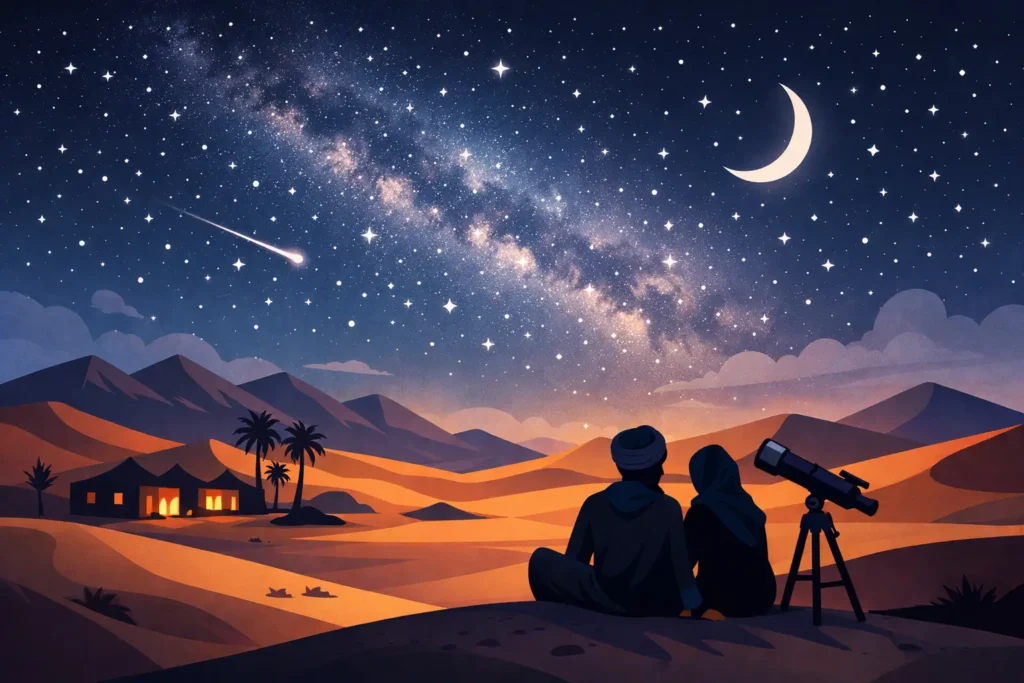
The moment the camp lights soften and the last conversation fades, the Sahara changes character. Around Merzouga’s Erg Chebbi dunes, there are no city skylines, no streetlamps and very little light pollution between you and the horizon. On a clear night, the Milky Way can appear as a pale band above the sand. This Sahara stargazing travel guide explains how to plan that experience properly, from choosing the right season and desert camp to understanding the long journey that makes the night feel so rewarding.
Why the Moroccan Sahara is made for stargazing
Morocco’s Sahara offers the three things a memorable night sky needs: wide-open horizons, dry air and darkness. The dunes near Merzouga are particularly well suited because camps sit beyond the village lights, often deep enough in the sand to make the landscape feel completely removed from daily life.
The experience is not only about spotting constellations. It is the combination of a camel ride or 4×4 transfer at sunset, dinner in camp, Berber music by the fire and a quiet walk beyond the tents after dark. For couples, families and small private groups, it is one of the most atmospheric ways to experience Morocco.
That said, conditions are never guaranteed. A full moon brightens the dunes beautifully but reduces the number of visible stars. Wind can bring haze, and occasional cloud cover is possible, particularly outside the driest months. A good local driver and camp team can help you make the most of the evening, but the sky always has the final say.
Best time for Sahara stargazing in Morocco
For most travellers, October to April offers the best balance of comfortable touring weather and clear desert nights. Daytime temperatures are easier for road travel, camel trekking and dune walks, while evenings are cool enough to make sitting outside enjoyable with the right layers.
Autumn and spring: the best all-round choice
October, November, March and April are excellent months for a desert itinerary. Days are generally pleasant, nights are cool rather than severe, and you can spend more time outside without the intense heat of high summer. These months are especially suitable for first-time visitors combining Marrakech, the Atlas Mountains, Ait Ben Haddou, the Dades Valley and Merzouga.
Spring can occasionally bring dusty conditions, so flexibility is useful. If stargazing is your highest priority, plan at least two nights in the desert region rather than relying on a single evening.
Winter: crisp skies and cold nights
December through February can deliver wonderfully clear skies. The trade-off is the temperature. Once the sun sets, desert air cools quickly, and early mornings can feel close to freezing. Luxury camps usually provide proper bedding, but warm sleepwear, thick socks, a hat and a fleece are essential.
Winter is a strong choice for travellers who prefer cooler daytime sightseeing and do not mind wrapping up after dinner. It is also a good period to book a private camp experience, as the desert feels quieter outside the festive holiday dates.
Summer: possible, but plan around the heat
June to September is not impossible for Sahara travel, but the heat changes the rhythm of the trip. Daytime excursions need to be limited, air-conditioned transport becomes more important, and sunset activities are far more comfortable than midday plans. The reward is a warm evening outside, but high temperatures can make the long drive to Merzouga demanding.
For summer holidays, a tailored route with early departures, a quality camp and sensible stops is far better than trying to cover too much ground in one day.
Plan around the moon, not just the weather
If you want the greatest number of stars, travel close to a new moon. During this period, the moonlight is minimal and the Milky Way, planets and smaller constellations stand out more clearly. A new-moon window is ideal for keen photographers and anyone who wants the darkest possible sky.
A bright or full moon is not a poor choice. It creates a silver glow over the dunes, making the desert easier and safer to walk through at night. The view is more dramatic in a different way, although faint stars will be less visible. Families and travellers more interested in the overall desert atmosphere may prefer this softer, moonlit setting.
For the best compromise, consider the few nights before or after the new moon. You may have some gentle moonlight early or late in the evening, with a darker sky during the middle of the night.
Getting to the best stargazing areas
Merzouga, at the edge of Erg Chebbi, is the most practical choice for a first Sahara journey. It has the famous orange dunes many travellers picture when planning Morocco, a wide choice of desert camps and straightforward access from Marrakech or Fes on a private multi-day route.
From Marrakech, allow at least three days for a return journey if you want to enjoy the route rather than simply endure it. The classic journey passes through the High Atlas, Ait Ben Haddou, Ouarzazate, the Rose Valley or Dades Gorge, Todra Gorge and Erfoud before reaching Merzouga. A four-day route gives more breathing room and a better chance to arrive at camp before sunset.
From Fes, a two- or three-day desert route can work well, travelling through Ifrane, the cedar forests near Azrou, Midelt and the Ziz Valley. This is often the best option for visitors who want to begin in one imperial city and finish in another, rather than retracing the same road.
Zagora and the dunes around M’Hamid are alternatives for those with less time from Marrakech or an interest in a more remote desert landscape. However, the dunes are generally less towering than Erg Chebbi, and the drive remains substantial. For a classic first Sahara stargazing experience, Merzouga is usually the stronger choice.
Choose a camp that protects the quiet
Not every desert camp offers the same night-sky experience. Some are lively, social and close to other camps. Others are smaller, more private and positioned farther into the dunes. Neither is automatically better – it depends on the kind of evening you want.
For honeymooners, anniversary trips and travellers seeking stillness, a private or luxury camp with fewer tents is worth considering. Ask whether the camp uses low lighting after dinner, whether there is music late into the night and how far it is from the nearest vehicle access point. Small details make a real difference when you want to hear the desert as well as see the sky.
Comfort also varies. Many well-run camps have en-suite tents, hot showers, proper beds and charging points, while more traditional camps may offer simpler shared facilities. A comfortable tent does not weaken the desert experience. For most travellers, it means they can relax outdoors longer and enjoy the early morning light without worrying about a difficult night’s sleep.
At Morocco Customized Tours, private desert itineraries can be shaped around your preferred level of comfort, from a family-friendly camp to a more exclusive stay with private transport and a flexible pace.
What to bring for a better night under the stars
The desert rewards simple preparation. Bring a warm outer layer even in shoulder season, as temperatures often fall sharply after sunset. Closed shoes are more practical than sandals for walking on cooler sand at night, and a small torch with a red-light setting is useful because white light affects your night vision.
Keep your mobile phone on low brightness and avoid using flash. If you are taking photographs, a tripod, a camera capable of manual settings and a remote shutter release will help. Your guide or camp host may know a darker spot beyond camp, but do not walk far alone in unfamiliar dunes, especially after music and dinner when directions become harder to judge.
A reusable water bottle, lip balm and a light scarf are useful during the daytime journey as well. Desert travel is not only about the night; a comfortable drive and sensible clothing let you arrive with energy for the moment you came to see.
Make time for more than one desert night
The most common mistake is treating Merzouga as a single overnight stop squeezed between long drives. You may still see stars, but you can miss the calm that makes the Sahara special. Arriving before sunset, staying two nights and leaving after sunrise gives the experience room to unfold.
With two nights, you can enjoy one evening without a packed schedule, take a morning dune walk, visit a nearby nomad family or Khamlia village, and keep the second night available if the first is cloudy or windy. It also makes the journey kinder for children and for anyone who prefers a less rushed holiday.
A well-planned Sahara night does not need complicated equipment or expert astronomy knowledge. It needs a dark camp, a clear patch of sky, warm layers and enough time to stop looking at the clock. Let your route leave space for that silence – it is often the part of Morocco travellers remember longest.