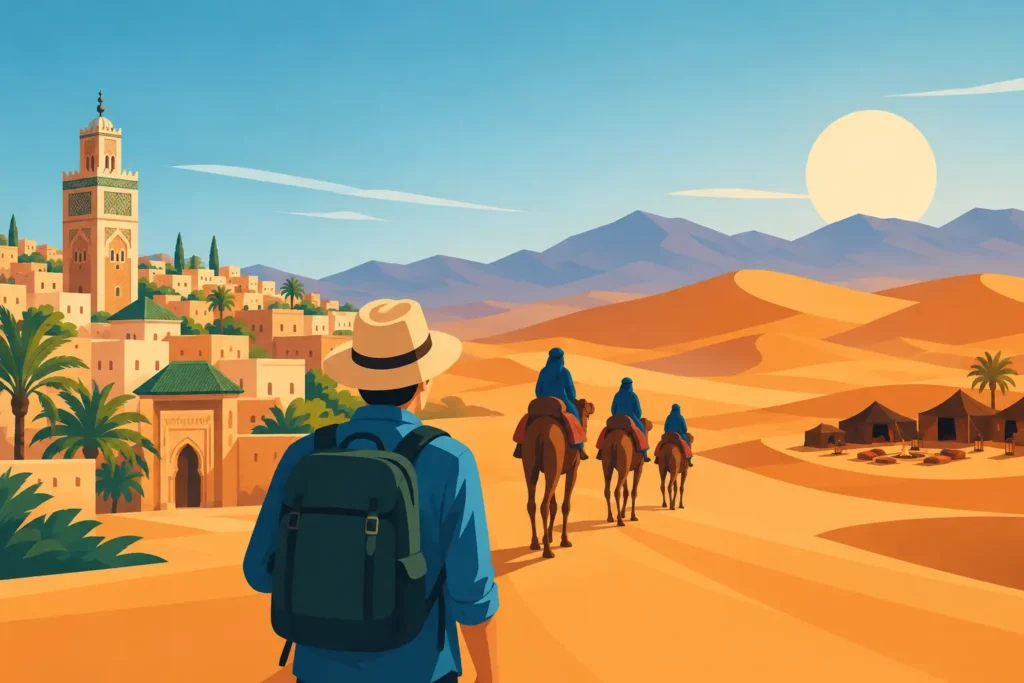
The road from Fez to the Sahara changes quickly: cedar forests give way to high passes, palm-filled valleys and, finally, the wide dunes of Merzouga. A fez desert tour 3 days is the right choice for travellers who want a genuine Sahara experience without sacrificing too much time from a wider Morocco holiday. It is a full route with long but rewarding drives, local stops and two very different overnight experiences.
For couples, families and small groups, a private journey makes the difference. You can travel at your pace, pause for photographs or a relaxed lunch, and adjust the day around your interests. With an experienced Moroccan driver-guide, the route becomes part of the experience rather than simply the distance between Fez and the desert.
What to expect from a Fez desert tour 3 days
Three days is enough time to reach the Erg Chebbi dunes near Merzouga, spend a night close to the sand and return to Fez. It is not a slow-paced desert retreat: the first and final days involve several hours on the road. In return, you see a remarkable cross-section of Morocco, from the Middle Atlas to the Ziz Valley and the edge of the Sahara.
The classic route is usually arranged as a private round trip. You leave Fez in the morning, travel south through Ifrane and the cedar forests around Azrou, continue past Midelt and the Ziz Valley, then arrive in Merzouga by late afternoon. The second day is reserved for the desert, while the third day returns north to Fez.
Some travellers prefer to spend the first night in a kasbah or desert lodge before their camp night. This can reduce the pressure of the journey, but it also means less time in the dunes. The best arrangement depends on your arrival time in Fez, your comfort preferences and whether the desert is the main purpose of your holiday.
Day 1: Fez, Ifrane and the road to Merzouga
Your driver collects you from your riad, hotel or airport area in Fez, normally after breakfast. The journey begins through the Middle Atlas, where the climate and scenery can surprise first-time visitors. Ifrane is known for its neat alpine-style architecture and cool winters, while the nearby cedar forest offers a chance to see Barbary macaques in their natural surroundings.
From here, the route continues towards Midelt, a practical place for lunch between the mountains. After Midelt, the landscape becomes drier and more dramatic. You cross mountain roads and descend towards the Ziz Valley, where long ribbons of date palms follow the river beneath ochre cliffs.
Stops may include panoramic viewpoints, small villages and fossil workshops around Erfoud, depending on timing. By late afternoon, the first dunes of Erg Chebbi come into view. These are the famous golden dunes associated with Merzouga, rising directly from the desert plain.
You may stay in a comfortable desert hotel at the dune line or continue by camel, 4×4 or both to a camp. Camel trekking is memorable, particularly near sunset, but it is not essential for everyone. Families with young children, guests with mobility concerns or travellers who simply prefer a smoother journey often choose a 4×4 transfer. A private tour should give you that choice.
At camp, expect a traditional Moroccan dinner, time beneath a clear night sky and accommodation ranging from simple nomad-style tents to luxury tents with private bathrooms. Camp standards vary considerably, so it is worth confirming what is included before booking.
Day 2: Sahara dunes, nomad culture and desert time
Wake early if you would like to see sunrise over the dunes. The light changes minute by minute, turning the sand from soft pink to deep gold. Afterwards, enjoy breakfast and decide how active you want the day to be.
A well-planned desert day can include a 4×4 circuit around Erg Chebbi, a visit to a nomad family, a stop in the seasonal village of Khamlia and time for sandboarding. Khamlia is known for Gnawa music, rooted in the cultural heritage of communities with sub-Saharan origins. A respectful visit offers more than a performance: it provides context for a part of Morocco that many hurried itineraries miss.
You can also visit Rissani, an important former caravan town with a traditional market on selected days. It is especially interesting for travellers who want to understand how desert trade shaped southern Morocco. Dates, spices, livestock and everyday goods still move through its market streets.
The afternoon should not be over-scheduled. The desert has its own rhythm, and a little unplanned time is valuable. Relax at your lodge, take a guided walk near the dunes, or head out for sunset from a quieter viewpoint. Your second night can be spent in a desert camp or a lodge, depending on the level of comfort you want and the weather conditions.
Day 3: Merzouga to Fez
After breakfast, the return journey follows the eastern route back towards Erfoud, the Ziz Valley, Midelt and the Middle Atlas. It is a long day, but breaks are built in for lunch, photographs and refreshments. Most private tours arrive back in Fez in the late afternoon or evening.
This return is the practical trade-off of a three-day itinerary. Travellers who dislike long driving days may be better suited to a four-day route, with an additional night in the Dades Valley, Skoura or Ouarzazate. That option gives more time for kasbahs, gorges and relaxed sightseeing. However, if your holiday has limited dates and you want to include the Sahara, three days from Fez is a strong, efficient choice.
Choosing the right desert camp and vehicle
The quality of your desert night often shapes the whole trip. Standard camps offer a friendly, traditional atmosphere and the essentials for a comfortable stay. Luxury camps offer more privacy, larger tents, proper beds, private facilities and a more refined dinner setting. Neither is automatically better: some travellers value a simpler, quieter camp, while others want hotel-level comfort after a full day on the road.
Vehicle choice matters too. For most private tours, a modern air-conditioned 4×4 or spacious minivan is ideal. A 4×4 is useful for desert tracks and can be more comfortable on certain rural sections. Larger families and groups may prefer a minivan for extra space. Ask about luggage capacity if you are travelling with large cases, as desert transfers sometimes require practical planning.
At Morocco Customized Tours, private itineraries can be tailored around the places you genuinely want to see, the camp style you prefer and the language in which you feel most comfortable. English, French and Spanish-speaking support helps make a long route feel relaxed and well organised.
Practical advice before you go
Pack for temperature changes. Desert afternoons can be warm, but nights are cooler, particularly from late autumn to early spring. Bring layers, sun cream, sunglasses, closed shoes for walking on sand and a light scarf for wind or dust. A small day bag is useful if your main luggage remains in the vehicle while you stay at camp.
Spring and autumn usually provide the most comfortable balance of temperatures. Summer can be intensely hot in Merzouga, although early starts, air-conditioned transport and a quality camp help. Winter days are often bright and pleasant, but evenings can become genuinely cold. Weather, not just the calendar, should guide what you pack.
Book a private tour with clear details on accommodation, meals, camel or 4×4 transfers, entrance fees and pick-up arrangements. The lowest quote is not always the best value if it leaves out camp quality, guide experience or reliable transport. Local knowledge is especially valuable on this route because road conditions, market days and desert weather can affect the best plan.
Give yourself one relaxed evening in Fez after returning from the Sahara. After three days of mountain roads, dunes and big desert skies, a mint tea on a riad terrace is a fitting way to let the journey settle in.