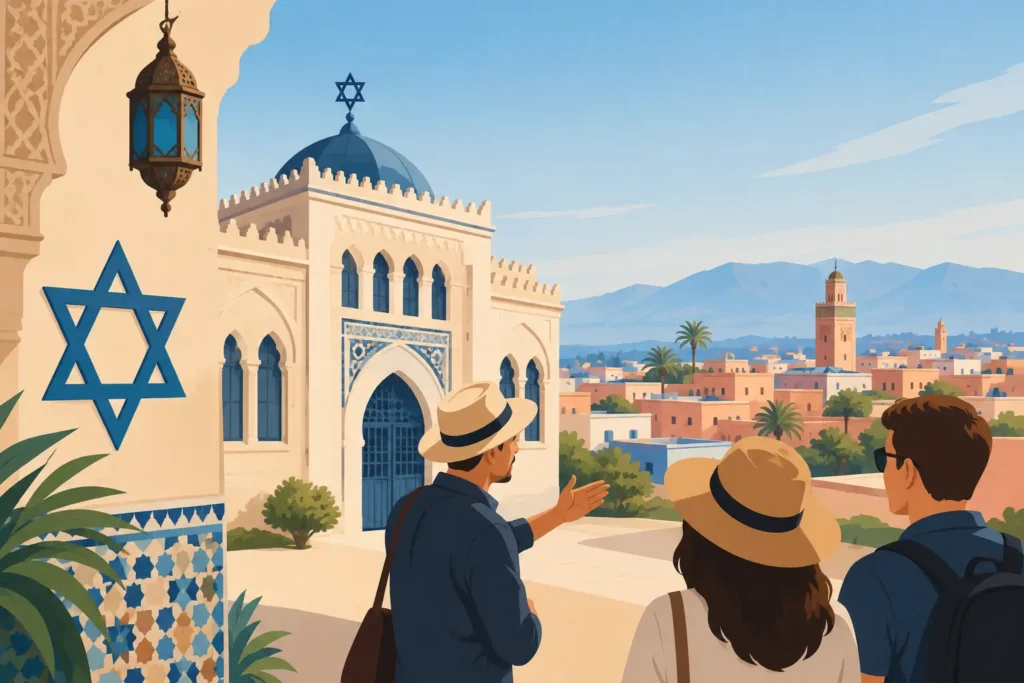
The whitewashed walls of a mellah, the quiet courtyard of a synagogue, the carved Hebrew inscriptions above an old doorway – Morocco’s Jewish heritage is present in places many visitors pass without recognising. This Morocco Jewish heritage guide helps you plan a respectful, well-paced journey through a history that remains woven into the country’s cities, food, music and family stories.
Morocco was once home to one of the largest Jewish communities in the Arab world. For centuries, Jewish and Muslim Moroccans lived, traded and celebrated alongside one another in imperial cities, coastal ports and mountain villages. Today, the community is smaller, but its heritage is carefully preserved in synagogues, cemeteries, museums and neighbourhoods across the country.
For travellers, the best experience comes from placing these sites within a wider private itinerary. A knowledgeable local guide can explain what you are seeing, arrange appropriate visiting times and connect Casablanca, Fes, Marrakech, Essaouira and the Atlas region without turning a meaningful cultural journey into a rushed checklist.
Morocco Jewish Heritage Guide: Where to Begin
Casablanca is the strongest starting point for many visitors, especially those arriving by air. It is home to Morocco’s largest contemporary Jewish community and several active synagogues. The Museum of Moroccan Judaism, located in the city, gives valuable context before visiting older heritage sites elsewhere. Its collections show religious objects, traditional dress, photographs and everyday items that bring Jewish Moroccan life into focus.
Casablanca also offers a useful introduction to the continuing relationship between Morocco’s Jewish past and present. Visits to functioning religious buildings need to be arranged with care, and access may depend on security procedures, religious holidays and the time of year. This is one area where a private guide and pre-arranged itinerary make a real difference.
From Casablanca, travellers can continue to the imperial cities, the Atlantic coast or the south. The right route depends on how much time you have and whether Jewish heritage is the main purpose of your holiday or one important thread within a broader Morocco tour.
Fes: The Historic Mellah and Sacred Sites
Fes is essential for travellers interested in the long history of Jewish Morocco. The city’s mellah, established beside the Royal Palace in Fes el Jadid, was once a lively Jewish quarter with homes, workshops, markets and places of worship. Its position near the palace reflected both protection and the community’s importance to the city’s commercial and diplomatic life.
Walk through the mellah with a guide who can point out details that are easy to miss: balconies that differ from the traditional medina style, street names, cemetery walls and traces of former community buildings. The atmosphere is quieter today, but the neighbourhood remains deeply significant.
The Ibn Danan Synagogue is one of Fes’s best-known Jewish heritage sites. Its modest exterior gives little away. Inside, visitors can see the prayer room, wooden furnishings and ritual spaces that reveal how a synagogue served a close-knit neighbourhood. The Jewish cemetery nearby, with its white tombs set against the city walls, is another moving stop.
Allow at least one full day in Fes if you want to combine the mellah with the city’s wider heritage. The medina, tanneries, craft quarters and historic madrasas help explain the commercial and cultural setting in which Jewish and Muslim communities shared urban life.
Marrakech: Heritage Behind the Medina Walls
Marrakech’s mellah is one of the city’s most rewarding cultural areas, yet it is often missed by first-time visitors focused on Jemaa el-Fna and the souks. Located close to the Bahia Palace, it was historically a busy district of traders, jewellers and artisans.
The Lazama Synagogue is a key stop. Its blue-and-white tiled courtyard and intimate prayer hall offer a calm contrast to the intensity of the surrounding medina. The nearby Jewish cemetery, with its hundreds of pale tombs, provides a powerful sense of the community that once lived here.
A visit to the mellah works particularly well on a private Marrakech city tour. You can combine it with the Bahia Palace, Saadian Tombs and the old markets, while leaving enough time to hear the stories rather than simply taking photographs. In busy periods, an early start is usually more comfortable and gives you a quieter view of the neighbourhood.
Essaouira: A Coastal Story of Trade and Coexistence
Essaouira has a distinctly different Jewish history. This Atlantic port was a centre of international trade, and Jewish merchants played a major role in connecting Morocco with Europe and beyond. At one point, Jews made up a substantial proportion of the town’s population.
Within the old medina, the former mellah has been restored in parts, with heritage signs and community initiatives helping visitors understand its past. The Simon Attias Synagogue, also known as Slat Lkahal, is an important landmark, and the town’s Jewish cemetery looks out towards the sea.
Essaouira is an excellent choice for travellers who prefer a slower pace. Two nights allow time to explore the medina, harbour and ramparts as well as its Jewish heritage. It also combines easily with Marrakech, making it a practical addition to a week-long private Morocco itinerary.
The South and Atlas Mountains: Smaller Communities, Deep Roots
Beyond the major cities, Jewish heritage survives in villages and market towns across southern Morocco. Communities once lived in places such as Taroudant, Ouarzazate, Tinghir and the valleys leading towards the Sahara. Their histories are closely linked to caravan trade, agriculture, crafts and local Amazigh culture.
Tinghir is especially meaningful for travellers heading to Merzouga and the Sahara. Its old mellah and Jewish cemetery offer a quieter, more personal perspective than the larger city sites. Conditions and access can vary, so this is not a destination to approach as a fixed, self-guided stop. A locally organised route is more respectful and more reliable.
If your holiday includes Marrakech, the High Atlas, Ait Ben Haddou, Ouarzazate and the desert, ask for Jewish heritage stops to be included where they genuinely fit the journey. It may add time to driving days, so the best choice is often a longer route of six to ten days rather than trying to squeeze everything into a short break.
How to Visit Respectfully
Jewish heritage sites are not simply historic attractions. Many remain places of worship, remembrance and family connection. Dress modestly, speak quietly and always follow the guidance of the caretaker or guide. Men may be asked to cover their heads in a synagogue, and photography may be restricted, particularly during services or at sensitive sites.
Opening hours can be flexible rather than fixed. Religious festivals, Shabbat, restoration work and local arrangements may affect access. This is why independent plans copied from an old travel guide can disappoint. A private itinerary organised locally can confirm visits in advance and provide alternatives if a particular site is unavailable.
It is also worth allowing space for conversation. Moroccan Jewish heritage is not confined to buildings. You may hear about family names, Andalusian music, jewellery-making traditions, shared dishes and the annual pilgrimages held at saints’ tombs. These stories often become the most memorable part of the visit.
Suggested Private Routes for Jewish Heritage Travel
For a first visit of five to seven days, Casablanca, Rabat, Fes and Marrakech create a strong cultural route. Begin in Casablanca for the museum and contemporary context, continue to Fes for its historic mellah and synagogue, then travel south to Marrakech for the Lazama Synagogue and Jewish quarter.
With eight to ten days, add Essaouira for its Atlantic trading history or continue from Marrakech through the Atlas Mountains towards Ouarzazate, Tinghir and Merzouga. This longer journey gives you time for Morocco’s Jewish heritage alongside kasbahs, mountain scenery and a Sahara desert experience.
For families or travellers who value comfort, a dedicated driver-guide is especially useful. Distances between cities can be longer than they appear on a map, and the best heritage visits often require flexible timing. Private travel lets you set the pace, choose accommodation that suits your style and include cultural stops without worrying about group-tour schedules.
Morocco Customised Tours can tailor these routes around your arrival city, preferred hotels, interests and available days. Whether you are travelling for family history, faith, culture or simple curiosity, local planning helps turn a collection of sites into a journey with real context.
Leave room in your itinerary for the unexpected: a caretaker sharing a memory, a Hebrew inscription on a medina wall, or a meal that reveals how closely Morocco’s communities have shaped one another. Those quiet moments are often where the country’s heritage feels most alive.