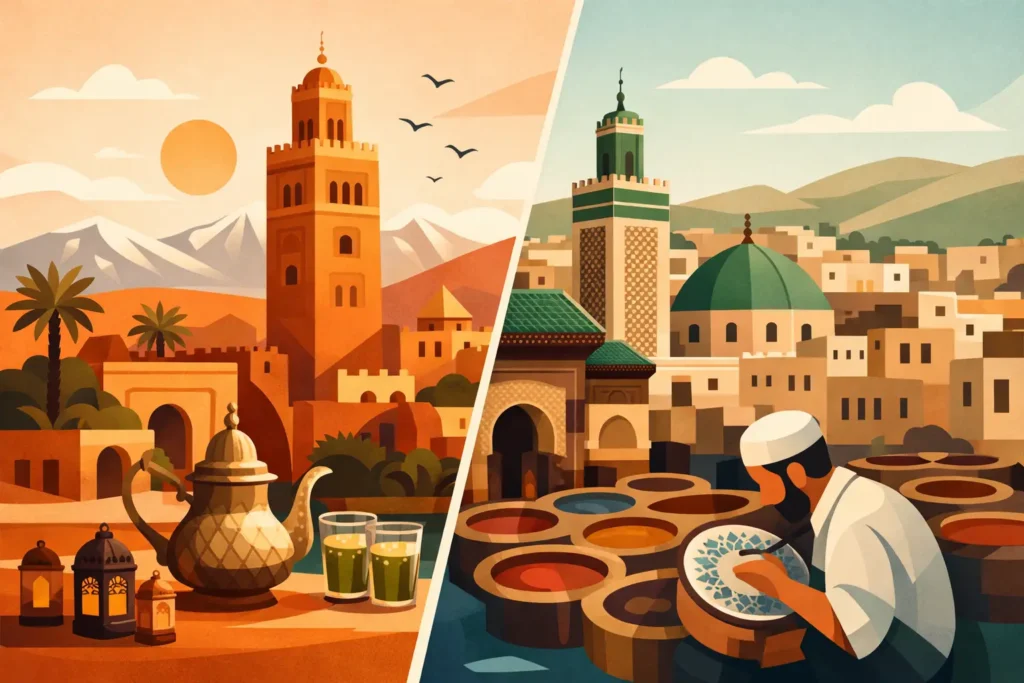
At 8am, Marrakech is already setting its stage: scooters weave through the medina, orange juice is pressed beside the square, and shopkeepers are ready for the day. In Fes, the morning often feels more inward-looking, with bakery scents in narrow lanes and the measured rhythm of neighbourhood life. Marrakech versus Fes culture is not a question of which city is more Moroccan. Both are essential imperial cities. The real question is which kind of cultural experience you want to feel first.
For many travellers, Marrakech is Morocco at its most energetic, visual and social. Fes is Morocco at its most intricate, historic and craft-led. A private itinerary can include both, but understanding their different character helps you choose the right pace, accommodation and number of nights for your holiday.
The central difference between Marrakech and Fes
Marrakech is a city of encounters. Its public life is immediate: the spectacle of Jemaa el-Fna after sunset, rooftop terraces, gardens, food stalls, contemporary galleries and riads hidden behind busy streets. It has long welcomed merchants, artists and travellers from across Morocco and beyond, and that openness is still part of its personality.
Fes rewards a slower, more observant approach. Its old medina is less about grand public display and more about skilled work, faith, learning and family neighbourhoods. Behind plain doorways are tiled courtyards, old fondouks, workshops and historic religious institutions. You may not always know what lies around the next corner, which is precisely why a knowledgeable local guide makes such a difference here.
Neither experience is more authentic than the other. Marrakech can feel intense and polished in the busiest areas, while Fes can feel quieter but more demanding to navigate. Your preferred style of travelling matters.
Marrakech versus Fes culture in daily life
Marrakech: expressive, cosmopolitan and high-energy
Marrakech has a confidence that visitors notice straight away. Djemaa el-Fna is its best-known gathering place, where storytellers, musicians, food vendors and families shape the evening atmosphere. It is lively, sometimes noisy and often unforgettable. The square is not a museum piece, but it is also built around tourism, so the best experience comes from enjoying it with realistic expectations and local advice.
The medina’s souks are equally theatrical. You will see lanterns, leather slippers, woven baskets, spices, ceramics and textiles displayed in a colourful rush. Bargaining is part of the exchange, but a good guide can also point you towards respected artisans and explain the difference between handmade work and mass-produced souvenirs.
Outside the old walls, Marrakech has a more modern cultural layer than Fes. Gueliz offers design shops, cafés, restaurants and galleries, while the Palmeraie and nearby resorts offer a relaxed counterpoint to the medina. This makes Marrakech especially suitable for couples, first-time visitors and families who want cultural sightseeing alongside comfort, dining and flexible downtime.
Marrakech also sits close to the High Atlas Mountains. A day or overnight visit to Amazigh villages adds another cultural perspective, with mountain food, local markets and landscapes that feel far removed from the Red City’s bustle.
Fes: scholarly, traditional and detail-rich
Fes has been a centre of Islamic scholarship, trade and craftsmanship for centuries. Its cultural strength lies in the layers. A walk through Fes el-Bali can bring you past a communal bakery, a woodcarver at work, an ornate fountain and a neighbourhood mosque within minutes. Many streets are too narrow for cars, so the city unfolds on foot and at a human pace.
The city’s artisan traditions are central to its identity. Zellige tilework, carved cedar, brasswork, leather and pottery are not simply decorative souvenirs here. They are living skills passed through workshops and families. Watching a craftsperson work gives greater meaning to the geometric patterns and rich colours found in riads, palaces and historic madrasas.
Fes is often described as conservative, which is broadly true in comparison with Marrakech, but it should not be mistaken for unwelcoming. Visitors are warmly received when they dress respectfully, ask before photographing people and understand that some religious spaces are not open to non-Muslims. Its hospitality is quieter and more personal rather than outwardly performative.
Food in Fes often reflects this sense of tradition. You may find dishes prepared with careful use of sweet and savoury spices, preserved lemon, almonds and seasonal produce. A meal in a family-run riad or a cooking experience with a local host can be one of the most memorable ways to understand the city.
Choose Marrakech if you want energy and variety
Marrakech is usually the easier choice if your time in Morocco is limited. It has excellent flight connections, a wide range of riads and hotels, and a concentration of major sights that can be enjoyed in two or three full days. It is also a strong starting point for routes through the Atlas Mountains, Ait Ben Haddou, Ouarzazate and the Sahara.
Choose it if you enjoy busy markets, evening atmosphere, gardens, contemporary Moroccan design and having many restaurant options close at hand. It is a practical first stop for travellers who like a well-organised holiday but still want room for spontaneous discoveries.
The trade-off is that Marrakech can be demanding at peak times. Popular lanes become crowded, vendors may be persistent, and the heat is considerable in summer. A private guide, a centrally located riad and planned breaks during the warmest part of the day make the experience far more enjoyable.
Choose Fes if you want depth and heritage
Fes is ideal for travellers drawn to architecture, traditional crafts, local food and the story behind what they see. Allow at least two nights, preferably three, so you can explore the medina without rushing and include sites beyond it, such as the royal palace area, the Mellah and panoramic viewpoints above the city.
It works particularly well as part of a northern Morocco route that includes Casablanca, Rabat, Meknes, Volubilis and Chefchaouen. It is also a natural starting point for a journey south through the Middle Atlas towards Merzouga and the Sahara Desert.
The trade-off is logistical rather than cultural. Fes el-Bali is a maze, luggage may need to be carried for the final stretch to some riads, and independent navigation can quickly become frustrating. For a first visit, local guidance turns that complexity into one of the city’s greatest pleasures.
A cultural itinerary that includes both cities
If you have seven to ten days, there is no need to choose only one. Start in Marrakech for its public energy, then travel across the Atlas region and on to the Sahara. From Merzouga, continue through the Ziz Valley and Midelt to Fes. This route makes cultural sense: it connects the lively south-west, Amazigh mountain communities, desert landscapes and the historic north-east in one journey.
The order also creates a satisfying change of pace. After Marrakech’s colour and movement, the quiet roads, kasbahs and desert camps provide space to breathe. Fes then offers a more detailed final chapter, where you can look beyond the headline sights and understand the craft traditions that shape Moroccan homes and cities.
Morocco Customized Tours can tailor this type of private route around your interests, whether that means more time with artisans in Fes, a luxury desert camp, family-friendly activities in Marrakech or a slower journey with selected riads and a dedicated driver. Local planning matters because travel times, medina access and seasonal conditions can change the rhythm of the trip.
Practical cultural etiquette in both cities
Marrakech and Fes are welcoming cities, and simple consideration goes a long way. Dress modestly when walking through residential neighbourhoods and visiting religious or historic sites. Ask before taking close photographs of people, especially craftspeople who are working. Agree prices before a horse-carriage ride, informal service or market purchase, and carry some cash for small shops and tips.
Friday is the main congregational prayer day, so some places may open later or feel quieter around midday. During Ramadan, daily routines change and evening life becomes especially lively after sunset. These are not obstacles to travelling, but useful details when planning a thoughtful itinerary.
The best choice is the city that matches how you want to remember Morocco. Choose Marrakech when you want to be swept into its energy; choose Fes when you want to pause, look closely and let centuries of craftsmanship reveal themselves one courtyard at a time.