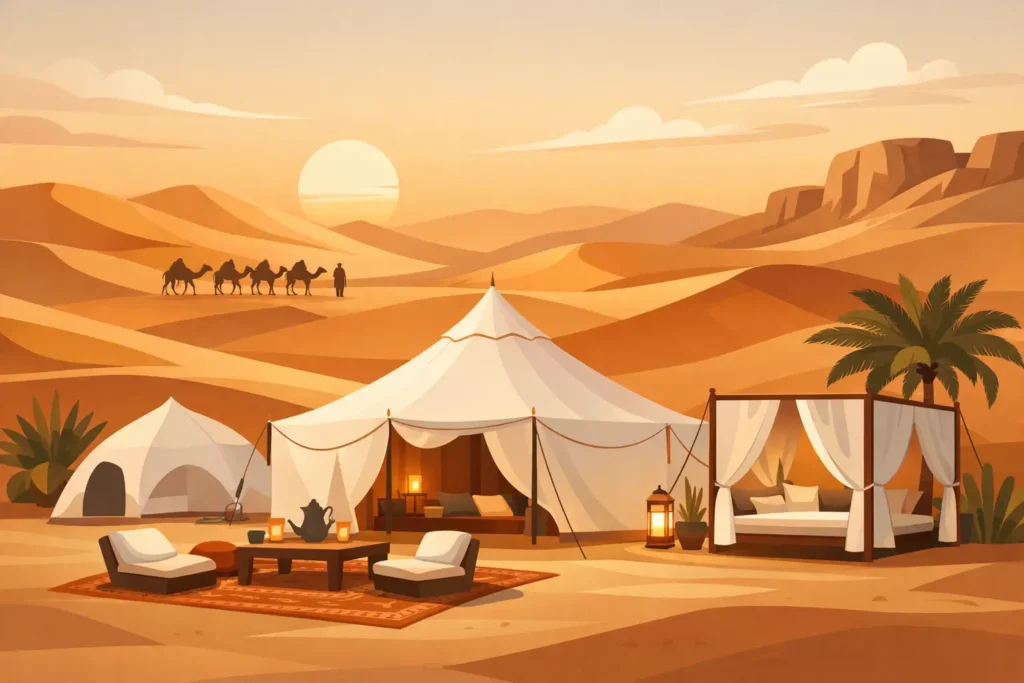
The silence after sunset is what most travellers remember. Beyond the last village near Merzouga, the dunes turn copper, the temperature drops, and the sky fills with stars that city lights usually hide. Sahara glamping gives you that desert setting without asking you to sacrifice a proper bed, a warm meal or the reassurance of experienced local hosts.
For couples, families and private groups, a well-planned camp stay is often the highlight of a Morocco itinerary. It is also an experience where details matter: which dunes you visit, how you reach camp, whether your tent has a private bathroom, and how much time you allow for the journey there. Here is how to choose the right experience and make the most of your night in the Moroccan Sahara.
What Sahara glamping really means
Glamping in the Sahara is not simply camping with decorative cushions. The better camps combine traditional desert-inspired design with the comforts international travellers value after a long day on the road. Expect spacious canvas tents, real mattresses and bedding, rugs, solar-powered lighting, a dining tent or open-air dining area, and attentive camp staff.
At a standard comfort camp, bathroom facilities may be shared and located a short walk from your tent. Luxury camps usually offer an en-suite bathroom with a toilet and shower, along with larger tents, upgraded linens and more privacy. Neither option is automatically better. A shared-facility camp can feel relaxed and sociable, while a private luxury tent suits honeymooners, families with young children, and anyone who prefers extra comfort.
The key is to ask what is included rather than relying on the word “luxury”. Confirm the bathroom arrangement, electricity, heating in colder months, dinner and breakfast, luggage handling, and the distance between the vehicle drop-off point and the camp.
Why Merzouga is the leading choice for desert camps
Morocco has several desert landscapes, but the great dunes of Erg Chebbi near Merzouga offer the classic Sahara image most visitors have in mind. These sweeping orange dunes rise dramatically from the edge of the village and create a striking setting for camel treks, 4×4 excursions and overnight camps.
Merzouga is usually reached on a multi-day route from Marrakech or Fes. From Marrakech, travellers often cross the High Atlas Mountains, visit Ait Ben Haddou and travel through the Dades Valley or Todra Gorge before arriving in the desert. From Fes, the route passes through the Middle Atlas, cedar forests and towns such as Ifrane and Midelt before continuing south towards Erfoud and Merzouga.
The drive is part of the holiday, not just transport. However, it is a long journey. A rushed two-day return trip from Marrakech may technically include a desert night, but it leaves little time to enjoy the landscapes or the camp itself. Three days is a sensible minimum from Marrakech, while four days creates a more comfortable pace. From Fes, a two- or three-day route can work well depending on where you plan to finish.
A typical Sahara glamping experience
Your desert stay normally begins in Merzouga or at a designated meeting point near the dunes. After leaving larger luggage securely with your driver or at the camp base, you will travel towards the camp by camel or 4×4. Many guests enjoy a camel ride at sunset, but it is not compulsory. A 4×4 transfer is the better choice for travellers with limited mobility, very young children, back concerns, or anyone who simply does not enjoy riding.
As evening arrives, staff welcome you with Moroccan mint tea. Dinner is usually served after sunset and may include soup, salad, tagine, couscous, grilled dishes and fresh fruit, with vegetarian and other dietary requirements arranged in advance. The atmosphere is informal but special: lanterns, quiet conversation and the dark outline of the dunes beyond the camp.
After dinner, some camps offer traditional music around a fire. Others keep the evening deliberately peaceful. Both styles have their appeal. If your priority is a quiet, romantic escape, request a camp with a calmer setting and fewer large groups. If you are travelling with friends or enjoy cultural entertainment, a livelier camp can be a memorable choice.
The next morning, wake early if you can. Sunrise is softer than sunset, and the dunes often appear almost pink before the day warms up. Breakfast follows before your camel or 4×4 return, where your private driver continues the next stage of your Morocco tour.
When to plan your desert stay
The most comfortable seasons for Sahara glamping are generally spring and autumn. From March to May and from late September to November, days are often warm without the strongest summer heat, while evenings are pleasantly cool.
Summer, particularly July and August, can be very hot. A luxury tent, air movement and an early morning or late afternoon activity plan make a difference, but the heat is still real. Travellers who are sensitive to high temperatures may prefer another season.
Winter brings clear skies and beautiful days, but desert nights can become surprisingly cold between December and February. Heating, thick blankets and warm sleepwear are essential. This period can be ideal for guests who enjoy cooler daytime conditions and do not mind crisp evenings, especially if they choose a well-equipped private camp.
What to pack for a luxury desert camp
Even the best camp is still in the desert, so practical packing improves the experience. Bring a light day bag for the overnight stay, while larger suitcases remain with your vehicle. Comfortable closed shoes are useful for walking on sand and around camp, although sandals are pleasant during the day.
Layers are more useful than one heavy item. A breathable shirt, light jumper or fleece, scarf, sunglasses and sun cream will cover most seasons. In winter, add a warmer jacket, socks and a hat for evenings. A small torch can be helpful, though established camps provide lighting. Keep cameras and mobile phones protected from sand, and bring a portable charger if taking many photos.
You do not need to overpack. Camp staff are used to hosting international travellers, and a private tour allows you to keep your main luggage in the vehicle. The aim is comfort, not expedition-level equipment.
Choosing between a shared camp and a private camp
A shared camp is a good fit for travellers who enjoy meeting others and want a more accessible price. It can still be comfortable and beautifully located, especially when the group size is controlled and the tents are well maintained.
A private camp experience offers more flexibility. You can choose your transfer time, dine at your own pace, request specific meals, and enjoy a quieter setting. This is especially valuable for anniversaries, proposals, multigenerational families and groups celebrating a special occasion. It also gives your guide and driver more freedom to adapt the route around your interests.
Location matters as much as tent style. Camps deeper among the dunes can feel more remote, but reaching them takes longer. Camps closer to Merzouga are easier for short itineraries and may be more convenient for families. There is no single right answer – it depends on whether you value maximum seclusion, time efficiency or a balance of both.
Make the desert part of a well-paced Morocco route
The Sahara works best when it is connected thoughtfully to the rest of Morocco. Rather than treating Merzouga as a quick overnight stop, build in time for the Atlas Mountains, kasbah villages, palm-filled valleys and local stops along the road. This turns the journey into a complete route through changing landscapes and communities.
Morocco Customized Tours designs private desert itineraries around your arrival city, available days, accommodation preference and travel style. With a Moroccan driver-guide handling the road distances, camp arrangements and local timing, you can focus on the moments that make the journey worthwhile: a sunset on the dunes, tea with local hosts, and a quiet morning in a landscape unlike anywhere else.
A Sahara camp should leave you with more than photographs. Give it enough time, choose comfort that suits your group, and let the desert slow the pace of your holiday for one unforgettable night.