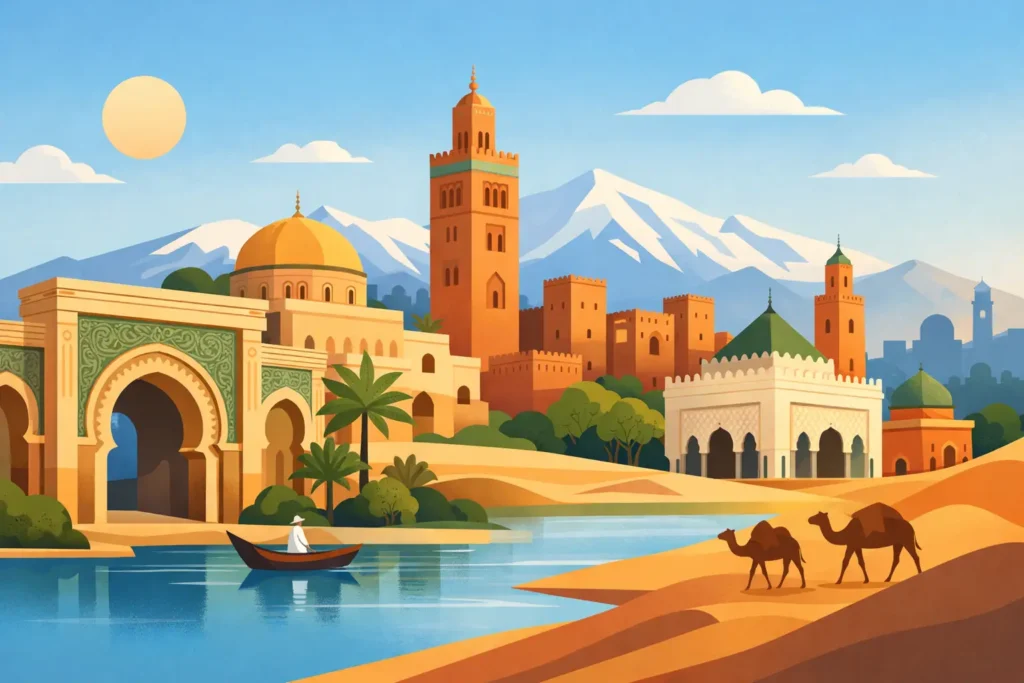
Morocco’s former capitals are not four versions of the same city. Marrakech is energetic and dramatic, Fes is deeply traditional, Meknes is calmer and more monumental, while Rabat feels polished, coastal and contemporary. Choosing the best imperial cities Morocco route is therefore less about ticking off names and more about matching the journey to your time, travel style and interests.
For first-time visitors, an imperial cities circuit offers Morocco at its richest: royal architecture, ancient medinas, artisan workshops, gardens, food markets and centuries of living history. With a private driver and local guide, the experience is also far easier to enjoy. The medinas can be confusing, the distances between cities are significant, and the best stories are often found behind unmarked doors rather than on a map.
Which are the best imperial cities in Morocco?
Morocco’s four imperial cities are Marrakech, Fes, Meknes and Rabat. Each served as a capital under a different dynasty, leaving its own character in the palaces, gates, mosques, walls and public spaces.
Marrakech is the best choice for travellers who want colour, energy and easy access to the Atlas Mountains or Sahara. Fes is the essential city for history lovers and anyone curious about Morocco’s crafts, scholarship and old-world urban life. Meknes works beautifully as part of a northern route, particularly when combined with Volubilis. Rabat suits travellers who appreciate a more relaxed capital city, ocean air and refined architecture.
If you have only four or five days, focus on Marrakech and Fes rather than rushing through all four. With seven to nine days, it becomes realistic to include Meknes and Rabat at a comfortable pace. A longer private holiday can combine the imperial cities with Chefchaouen, Casablanca, the Atlas Mountains or a Sahara desert expedition.
Marrakech: the imperial city of atmosphere
Marrakech was established as an imperial capital by the Almoravid dynasty in the 11th century, and it still knows how to make an entrance. The red city walls, date palms and distant Atlas peaks create an immediate sense of place. At its heart, Jemaa el-Fnaa changes character throughout the day, from fresh juice stalls and market activity to evening food stands and street performances.
The real pleasure of Marrakech is in balancing headline sights with quieter corners. Visit Bahia Palace for detailed painted ceilings and courtyards, then allow time for the Medersa Ben Youssef, the Saadian Tombs and the souks. A knowledgeable local guide can explain the difference between artisan-made goods and mass-produced souvenirs, and can help you navigate the medina without turning the day into a stressful search for landmarks.
Marrakech is also the most flexible base on an imperial city holiday. A day trip to the High Atlas can bring you into Berber villages, walnut groves and mountain valleys, while an overnight or multi-day route east leads towards Ait Ben Haddou, the Dades Valley and Merzouga. The trade-off is that Marrakech is busy, especially around the main square and popular riads. Travellers seeking quiet evenings may prefer to stay just outside the medina or schedule a few nights in the Palmeraie.
Fes: Morocco’s most immersive historic city
Fes is often the city visitors remember most vividly. Its old medina, Fes el-Bali, is a dense maze of alleys, fountains, caravanserais, workshops and family-run businesses. This is not a preserved museum. People live, study, trade and pray here every day, which is exactly what makes it so compelling.
The city became an imperial capital under the Marinids, whose legacy includes elegant religious colleges and carefully decorated public buildings. A guided visit can include the exterior of Al Quaraouiyine, one of the world’s oldest universities, the Bou Inania Madrasa, Nejjarine Museum area and the famous tanneries. The viewing terraces over the tanneries offer a memorable sight, although the natural dyes and working vats have a strong smell. Mint is often offered at the entrance for good reason.
Fes rewards travellers who slow down. Spend at least two nights here, ideally three if you want to include a food experience, a ceramic workshop or a visit to the surrounding countryside. The medina’s narrow lanes are not suitable for vehicles, so your driver will drop you at the nearest gate and your guide will lead the way on foot. This is one of the practical details that makes private planning worthwhile, particularly for families, older travellers or anyone carrying luggage.
Meknes: grand architecture without the crowds
Meknes is the most understated of Morocco’s imperial cities, and that is part of its appeal. Sultan Moulay Ismail made it his capital in the 17th century and built an ambitious city of walls, granaries, stables and ceremonial gates. The monumental Bab Mansour is among Morocco’s finest gateways, while the royal precinct gives a clear sense of the scale of the sultan’s vision.
Compared with Marrakech and Fes, Meknes is less intense and easier to absorb in a day or overnight stay. It is a strong choice for travellers who enjoy history but do not want every stop to feel crowded. Local life moves at a gentler pace around its squares and markets, and the city can provide a welcome change after the sensory rush of Fes.
Meknes is usually best paired with Volubilis, the remarkably well-preserved Roman archaeological site around 40 minutes away. Its mosaics, basilica and triumphal arch add another layer to a Morocco itinerary: Roman Africa before the Islamic dynasties. The nearby hilltop town of Moulay Idriss Zerhoun can also be included for a scenic lunch stop or a short walk through its whitewashed streets.
Rabat: a capital city with room to breathe
Rabat is Morocco’s modern capital, but its imperial past remains visible in the Kasbah of the Udayas, the Hassan Tower and the Mausoleum of Mohammed V. It is considerably calmer than Marrakech or Fes, with broad avenues, well-kept gardens and an Atlantic shoreline that brings a refreshing breeze.
For many private tour guests, Rabat is a pleasant surprise. The Kasbah’s blue-and-white lanes overlook the Bouregreg River, while the nearby medina is smaller and more manageable than those in Fes and Marrakech. The Chellah archaeological site, with Roman ruins and medieval walls, offers a peaceful place to pause among gardens and nesting storks.
Rabat makes the most sense on a route between Fes and Casablanca, or when travelling north towards Tangier and Chefchaouen. It is not usually the city to choose for a long stay if your priority is lively souks and late-night entertainment. However, for culture, comfort and a more spacious rhythm, it earns its place on the itinerary.
A practical imperial cities itinerary
A well-paced seven-day route can begin in Marrakech with two nights for the medina and major monuments. Travel onwards through the Middle Atlas to Fes for two or three nights, then continue to Meknes and Volubilis before finishing in Rabat or Casablanca. This route works particularly well for travellers arriving in Marrakech and departing from Casablanca, avoiding unnecessary backtracking.
For a nine or ten-day holiday, add an Atlas Mountains day, a food tour in Fes, or two nights in Chefchaouen after Rabat. If the Sahara is a priority, it is usually better to build a longer route from Marrakech to Fes via the desert rather than attempting to squeeze the dunes into a standard imperial cities circuit.
Private transport changes the experience significantly. You can stop for viewpoints, take breaks when needed and stay in carefully selected riads or hotels rather than being tied to a fixed group schedule. At Morocco Customised Tours, our Moroccan-born drivers and multilingual guides help shape these details around your interests, whether that means architecture, family-friendly pacing, shopping with trusted artisans or a more luxurious stay.
How to choose the right route for you
The best season for an imperial cities journey is generally spring or autumn, when daytime sightseeing is comfortable. Summer can be very hot in Marrakech and Fes, though early starts, air-conditioned transport and shaded riads make travel manageable. Winter brings cooler evenings and occasional rain, but it is often a rewarding time for travellers who prefer fewer crowds.
Do not underestimate travel time. Marrakech to Fes is a full road journey, while Fes to Meknes is much shorter and easy to combine with Volubilis. A thoughtfully planned route protects time for the places that matter: lingering over a rooftop breakfast in Fes, watching craftspeople at work, or enjoying the sunset from a Rabat terrace rather than spending every day in the car.
Choose the cities that genuinely appeal to you, then give them enough time to reveal themselves. Morocco’s imperial heritage is most memorable when there is room not only to see the gates and palaces, but also to hear the call to prayer crossing a medina, share mint tea with a local host and travel at a pace that feels like a holiday.