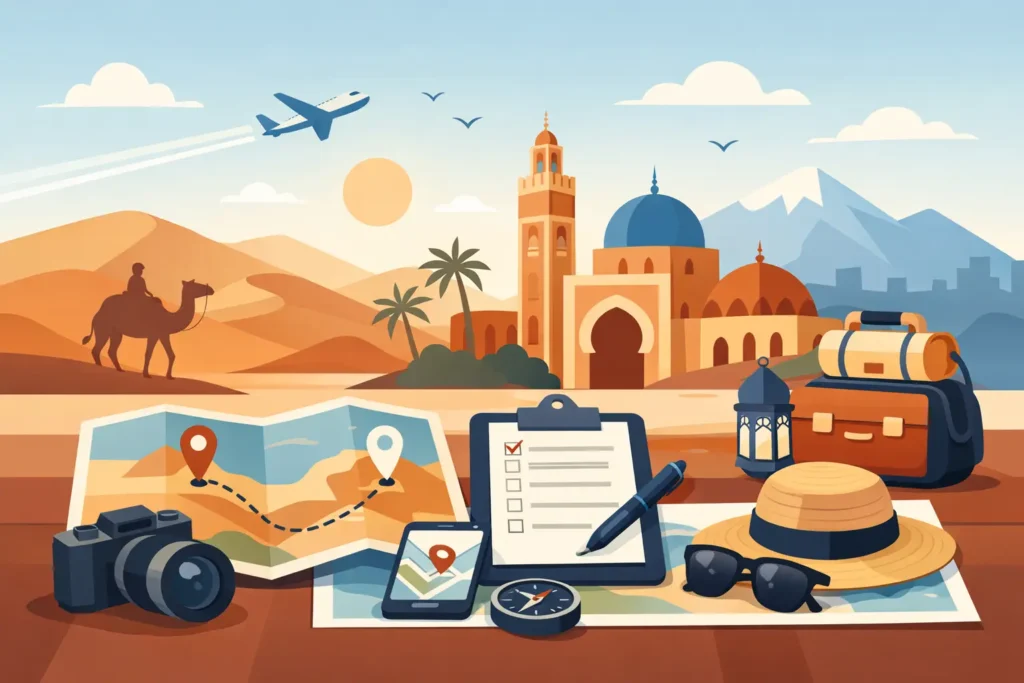
Landing in Morocco without a clear route usually sounds romantic right up until you are comparing transfer times, weighing up desert camps, and wondering whether Chefchaouen really fits your schedule. This Morocco tour planning guide is designed to make those decisions simpler, so you can build a holiday that feels exciting, well paced and genuinely suited to how you like to travel.
Morocco rewards good planning. The country offers huge variety in a relatively compact space – imperial cities, mountain valleys, Atlantic towns, ancient kasbahs and Sahara dunes – but travel times can be longer than many visitors expect. A strong plan is not about filling every day. It is about matching the right route, pace and level of comfort to your trip.
What a good Morocco tour planning guide should help you decide
Most first-time visitors start with the same questions. How many days do you need? Which cities are worth combining? Is the Sahara realistic on a shorter trip? Should you self-drive or book a private tour?
The right answer depends on your arrival city, travel style and priorities. If you want the classic highlights, Marrakech, Fes, the Sahara and perhaps Chefchaouen often make the best combination. If you prefer a slower holiday with less time on the road, Marrakech with the Atlas Mountains, Essaouira and one desert extension may work better. If you are arriving in Casablanca or Tangier, your route will naturally shift.
This is where local planning matters. Morocco is not difficult, but it is layered. Distances on a map do not always reflect road conditions, mountain passes, city traffic or the time you will want on the ground once you arrive.
Start with your entry point and trip length
Your flight usually shapes the smartest itinerary more than travellers expect. Marrakech is ideal for southern routes and desert trips through Ait Ben Haddou, Ouarzazate and Merzouga. Fes works well for northern and eastern combinations, especially if you want to add Chefchaouen before or after the desert. Casablanca is practical for broader circuits that include Rabat, Fes, Marrakech and the Sahara. Tangier suits travellers focusing on the north, including Tetouan, Chefchaouen and Fes.
Trip length matters just as much. With 5 to 6 days, trying to see everything often leaves you spending more time in the vehicle than in the destination. In that timeframe, it is usually better to focus on one region or one directional route. With 7 to 9 days, a classic city-and-desert circuit becomes much more comfortable. With 10 to 14 days, you can combine the imperial cities, Sahara, Atlas Mountains and perhaps the coast without rushing every stop.
A common mistake is underestimating the Sahara portion. Travellers often picture it as one overnight stop, but the journey there is part of the experience. The route through the High Atlas, kasbah landscapes and palm valleys deserves time. If the desert is one of your main reasons for visiting Morocco, give it at least three days within the itinerary.
Choosing the right route for your holiday
There is no single best route. There is only the route that fits your interests.
For first-time visitors who want Morocco’s best-known highlights, a Marrakech to Fes or Fes to Marrakech journey is one of the strongest options. It combines two very different imperial cities with the dramatic transition into the Sahara. You get souks, monuments, mountain scenery, Berber villages and a desert camp in one well-balanced trip.
If your priority is colour, atmosphere and photography, a northern route with Tangier, Chefchaouen and Fes offers a shorter and less road-heavy alternative. This works especially well for couples and travellers who prefer medinas, mountain towns and cultural discovery over long desert drives.
If you want a broader introduction, Casablanca, Rabat, Fes, the Sahara and Marrakech creates a fuller national circuit. It requires more days, but it gives a stronger sense of Morocco’s regional contrast. Luxury travellers and private groups often prefer this format because it blends comfort, structure and variety.
Families and travellers with younger children may do better with fewer hotel changes and shorter daily drives. In those cases, Marrakech with day trips to the Atlas Mountains, Agafay or Essaouira can be more relaxing than an ambitious cross-country route.
When to travel and what changes by season
One of the most useful parts of any Morocco tour planning guide is understanding the seasons honestly. Morocco is a year-round destination, but not every route feels the same in every month.
Spring and autumn are the easiest all-round seasons for most itineraries. Temperatures are generally pleasant for city touring, mountain excursions and desert travel. These months also suit first-time visitors who want a little of everything.
Summer can still work very well, but expectations should be adjusted. Marrakech and the Sahara can be intensely hot, especially in July and August. If you travel then, many visitors prefer a route with more time on the coast or in the mountains, or they choose premium accommodation where rest and air conditioning are part of the experience.
Winter is often underrated. Days can be beautiful and clear, especially in the south, and the light is excellent for sightseeing. The trade-off is colder mornings and nights, particularly in the desert and mountain areas. Snow in the Atlas can occasionally affect timing, so a flexible, well-managed itinerary is valuable.
Ramadan also shapes the travel atmosphere. Morocco remains welcoming and fully visitable, but some daytime rhythms change. For many travellers, that cultural dimension is part of the appeal. It simply means planning meals, timing and expectations with local awareness.
Private tour, small group or independent travel?
This is often the biggest practical decision. Independent travel can suit confident travellers staying mainly in major cities and using rail for simple routes such as Casablanca, Rabat, Fes and Marrakech. It offers flexibility, but it also means handling station transfers, local orientation, luggage movement and timing yourself.
For multi-day routes that include the Sahara, valleys, kasbahs and mountain roads, a private tour is usually the smoother option. It gives you a dedicated driver, structured timing and local guidance without the fixed pace of a large group. That matters in Morocco, where the quality of the journey often depends on local knowledge rather than just transport.
Small group tours can reduce cost, but they are less adaptable. If you value specific hotel preferences, slower mornings, added stops or family-friendly pacing, private travel is usually the better fit. That is why many visitors choose a customised route rather than trying to force their holiday into a one-size-fits-all itinerary.
Accommodation choices change the whole experience
Where you stay in Morocco shapes the trip more than many guests expect. A beautifully restored riad inside the medina gives a very different feeling from a standard city hotel. Desert camps also vary widely, from simple traditional setups to luxury tents with private bathrooms and stronger comfort levels.
There is no wrong choice, but there are trade-offs. Medina riads offer charm, architecture and atmosphere, though access can involve a short walk through narrow lanes. Modern hotels may be easier for guests who prioritise lifts, vehicle access and larger facilities. In the desert, standard camps can feel more adventurous, while luxury camps are better for travellers who want comfort after a long road journey.
A strong itinerary balances experience with practicality. Two or three high-character stays often create a more memorable holiday than booking every night purely on price.
Practical details that make planning easier
Pacing matters more than packing in attractions. It is better to see fewer places properly than to spend each day arriving somewhere new. Guided medina visits are also worth considering in cities such as Fes and Marrakech, where history and layout are far easier to appreciate with expert local context.
Airport arrival times should be checked against your first transfer. A late arrival into Casablanca, for example, may not pair well with an immediate long-distance road transfer. The same goes for departure days. Morocco runs on hospitality, but tight schedules still create avoidable stress.
It is also wise to think about your travel preferences before requesting a route. Do you enjoy scenic drives? Do you want shopping time in the souks? Is food a major part of the trip? Are you happy changing hotels often, or would you rather stay longer in fewer places? Clear answers lead to a better itinerary.
A Morocco tour planning guide works best when it stays personal
The strongest Morocco itineraries are not always the longest or the most expensive. They are the ones built around your real priorities, whether that means a luxury desert journey from Marrakech, a week linking Fes and Chefchaouen, or a full private circuit from Casablanca.
At Morocco Customised Tours, this is where local planning makes the difference. With Moroccan guides, flexible routing and private service, travellers can move beyond generic packages and shape a holiday that feels both organised and personal.
If you start with the right questions – where to begin, how long to stay, what pace suits you and which experiences matter most – Morocco becomes much easier to plan, and far more rewarding to experience. Your best trip is rarely the busiest one. It is the one that leaves enough room to enjoy where you are.