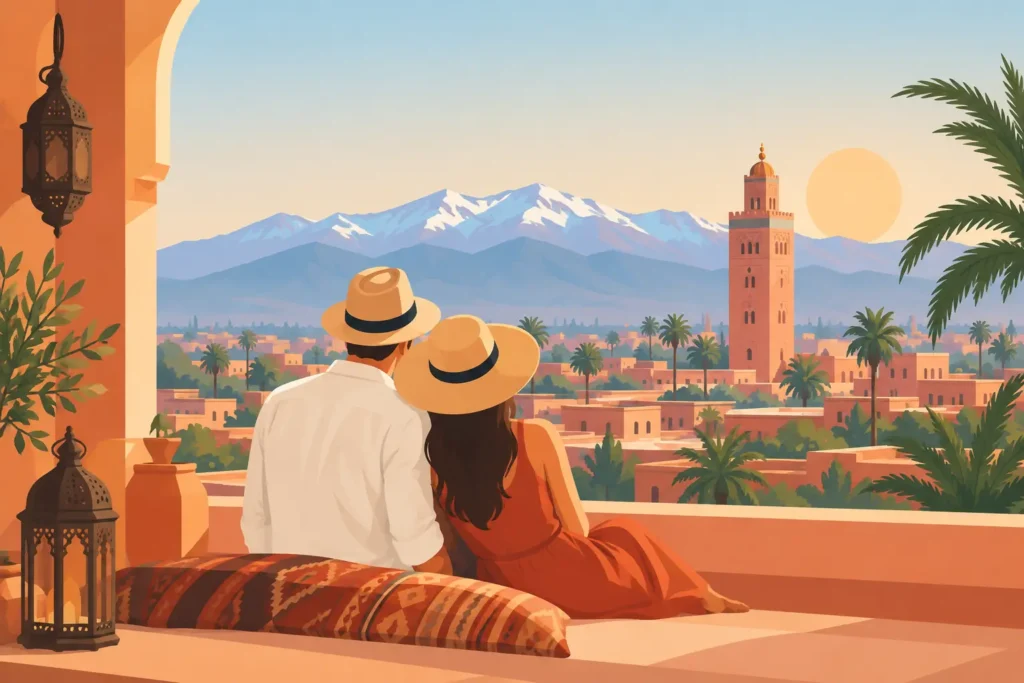
A two week Morocco honeymoon gives you time to enjoy the country rather than race through it. You can wake up among Marrakech riads, cross the High Atlas with your private driver, watch the sun set over Sahara dunes, and finish in the blue lanes of Chefchaouen or the Atlantic air of Casablanca. The key is choosing a route with enough contrast, but not so many hotel changes that your holiday becomes a packing exercise.
For couples, Morocco is at its best when the itinerary combines landmark sights with unhurried moments: a hammam and spa afternoon, a candlelit dinner in a restored riad, tea with a Berber family, and a quiet night beneath desert stars. A private tour makes these experiences easier to arrange around your own pace, with local guidance from arrival to departure.
The best route for a two week Morocco honeymoon
For most first-time visitors, the strongest 14-day route starts in Marrakech and finishes in Casablanca, Fes or Tangier. It follows a natural path through the Atlas Mountains and Sahara before turning north to Morocco’s imperial cities. You avoid unnecessary backtracking, while seeing the destinations couples most want to experience.
This suggested journey balances culture, scenery and comfort. It can be adjusted for a luxury honeymoon, a more active trip, or a slower holiday with extra nights in the places you love most.
Days 1-3: Marrakech, gardens, souks and riad living
Arrive in Marrakech and allow the first day to be gentle. Your driver can meet you at the airport and take you directly to a carefully chosen riad in the medina or a luxury hotel in the Palmeraie. After a long flight, there is no need to schedule every hour. A rooftop dinner overlooking the old city is often the perfect beginning.
The following day, explore Marrakech with a local guide. Visit Bahia Palace, the Saadian Tombs, the Koutoubia area and the lively souks around Jemaa el-Fna. A guide helps you understand the craft traditions behind the workshops, from leather and lanterns to woven textiles, without feeling pressured to shop.
Keep one day flexible. Some couples choose Majorelle Garden and the Yves Saint Laurent Museum; others prefer a couples’ hammam, a cookery class or a relaxed afternoon beside the pool. Marrakech is energetic, colourful and sometimes intense, so a little free time makes it more enjoyable.
Days 4-5: Aït Ben Haddou, Ouarzazate and the Dades Valley
Leave Marrakech by private vehicle and travel over the High Atlas via the Tizi n’Tichka pass. The road is winding, but the scenery is extraordinary: mountain villages, terraced fields and changing rock formations. Stop for photographs and coffee whenever you wish rather than following a fixed coach schedule.
Visit Aït Ben Haddou, the famous fortified ksar built from earth and straw. It is one of Morocco’s most photogenic places, especially in the softer light of late afternoon. Continue through Ouarzazate, known for its film history, and into the Dades Valley for an overnight stay in a charming kasbah hotel or boutique guesthouse.
The next morning, explore the Dades Gorges and travel through the Valley of Roses towards Skoura or the Todra Gorges. This section of the journey is where Morocco’s landscapes begin to feel vast and cinematic. It also offers a welcome change from the busy medinas.
Days 6-7: Merzouga and a private Sahara desert camp
From the gorges, continue east to Merzouga at the edge of the Erg Chebbi dunes. This is a longer driving day, but it leads to one of the defining experiences of a Morocco honeymoon. Arrive at your desert lodge, enjoy a rest, then ride by camel or travel by 4×4 into the dunes before sunset.
A quality private desert camp should feel romantic without pretending the Sahara is a resort. Expect a comfortable tent, proper bedding, private facilities where requested, Moroccan dinner and music by the fire. The real luxury is the setting: silence after dark, a sky full of stars and the dunes changing colour at sunrise.
On your second day in Merzouga, slow down. Visit a nearby nomad family, hear Gnawa music in Khamlia village, take a short off-road excursion, or simply enjoy the pool at a desert hotel. For a honeymoon, this extra night matters. A one-night Sahara visit can feel rushed; two nights allow you to experience the desert properly.
From the Sahara to Fes on your Morocco honeymoon
Days 8-10: Ziz Valley, Midelt and Fes
Travel north through the Ziz Valley, where long palm groves cut through the dry landscape. Stop in Midelt for lunch, then continue towards Fes through cedar forests near Ifrane. The route is varied and scenic, but it is also a full day on the road. Couples who prefer a slower rhythm can add an overnight stay in Midelt or the Middle Atlas.
Spend the next two days in Fes, Morocco’s spiritual and cultural heart. Its old medina is a maze of narrow lanes, historic madrasas, fondouks and traditional workshops. With a knowledgeable local guide, you can visit the artisan quarters, see the tanneries from a suitable viewpoint and discover the stories behind the city’s architecture.
Fes is less polished than Marrakech and that is part of its character. It feels lived-in, scholarly and deeply traditional. Choose a riad with a peaceful courtyard and terrace, then balance guided sightseeing with an evening meal where you can enjoy the city at a slower pace.
Days 11-12: Chefchaouen or Meknes and Volubilis
From Fes, there are two excellent directions. The first is Chefchaouen, the blue-painted mountain town in the Rif Mountains. Its lanes are compact, beautiful and ideal for couples who want a relaxed two-night stay with mountain views, small cafés and gentle walks.
The second option is Meknes and Volubilis. Meknes offers grand gates and imperial history, while Volubilis is Morocco’s best-known Roman archaeological site. This choice suits couples more interested in history than in photographing blue streets.
For many honeymooners, Chefchaouen is the better fit. It provides a quiet contrast to the larger cities and is especially lovely early in the morning before day visitors arrive. However, it involves more driving than Meknes, so the right choice depends on whether scenery or shorter travel days matters more to you.
Days 13-14: Casablanca, Rabat or Tangier departure
Finish your journey in the city that suits your flight plans. Casablanca is practical for international departures and worthwhile for the Hassan II Mosque, its Atlantic setting and a final seafood dinner. Rabat is calmer, with elegant boulevards, the Kasbah of the Udayas and a more relaxed capital-city atmosphere.
Tangier works well if you are departing north or continuing to Spain. Its port history, hillside views and creative energy give the honeymoon a distinctive final chapter. Your private driver can arrange a comfortable transfer, allowing you to enjoy the final morning rather than worrying about luggage, train times or road directions.
How to make the itinerary feel like a honeymoon
Accommodation makes a major difference. In Marrakech and Fes, choose intimate riads with beautiful rooms, attentive staff and easy access to the medina. In the desert, select a camp based on privacy and comfort rather than the lowest price. Not every camp offers the same standard of tents, bathrooms, dining or location among the dunes.
Private transport is equally valuable on a two-week journey. Morocco’s distances can be longer than they appear on a map, particularly between the mountains and Merzouga. A dedicated driver gives you flexibility for scenic stops, a later start after a relaxed breakfast, and practical support when plans change.
The best season depends on what you value. Spring and autumn offer pleasant conditions across most of the country, though popular sites are busier. Summer can be very hot in Marrakech and the Sahara, while winter brings cooler desert nights and occasional snow in the Atlas. A winter honeymoon can still be wonderful, provided you choose warm accommodation and pack layers.
At Morocco Customised Tours, we shape private honeymoon journeys around the details that matter to you, whether that means a luxury desert camp, a surprise celebration dinner, a slower pace or guides in English, French or Spanish. Local planning means the route can be realistic as well as romantic.
Give yourselves permission to leave a little space in the plan. Morocco rewards the unscheduled pause: mint tea on a quiet terrace, a sunset viewed from a kasbah wall, or a detour suggested by someone who knows the road ahead.